

Here's the honest version of the story that starts a lot of reviews like this one. My name is Walt, I'm 69, and I spent 34 years working as a lineman for the power company. That work gave me a lot of things, including high-frequency hearing loss that's worse in my left ear. My wife Joanne has normal hearing. For years, the TV volume was a tug of war. She'd turn it down, I'd turn it up, and eventually one of us would give up and go read in the other room. The Avantree Ensemble is the wireless TV headphone system we finally put in the middle of that fight.
I'll be plain with you: the Ensemble works, and it works well enough that I understand the fifteen thousand ratings on Amazon. But the product page doesn't tell you everything. There are setup quirks, comfort issues, and a few design decisions that only show up after a few weeks of daily use. That's what this review is for. I'm not an audiologist, and I'll say it again later, but if you're trying to fix a hearing problem, go see a professional. This is about making the TV easier to hear.
The Quick Verdict
A solid wireless TV headphone that fixes the volume wars, with a few setup and comfort quirks you should know about before you buy.
Amazon Check Today's Price →The TV volume wars end here
If you're tired of the turn-it-up, turn-it-down dance, the Avantree Ensemble is the peace treaty. See today's price and current ratings on Amazon before you decide.
Amazon Check Today's Price on Amazon →How I've Used It
My setup is a 55-inch TV in a brick ranch house, with my recliner about twelve feet from the screen. I used the Ensemble for the evening news, westerns, and a lot of baseball, which is the bulk of what I watch. Joanne used it a few times too, mostly to test what it sounded like from her side of the room. I wore the headphones for at least an hour most nights, sometimes three, which is long enough to find out where a product gets uncomfortable.
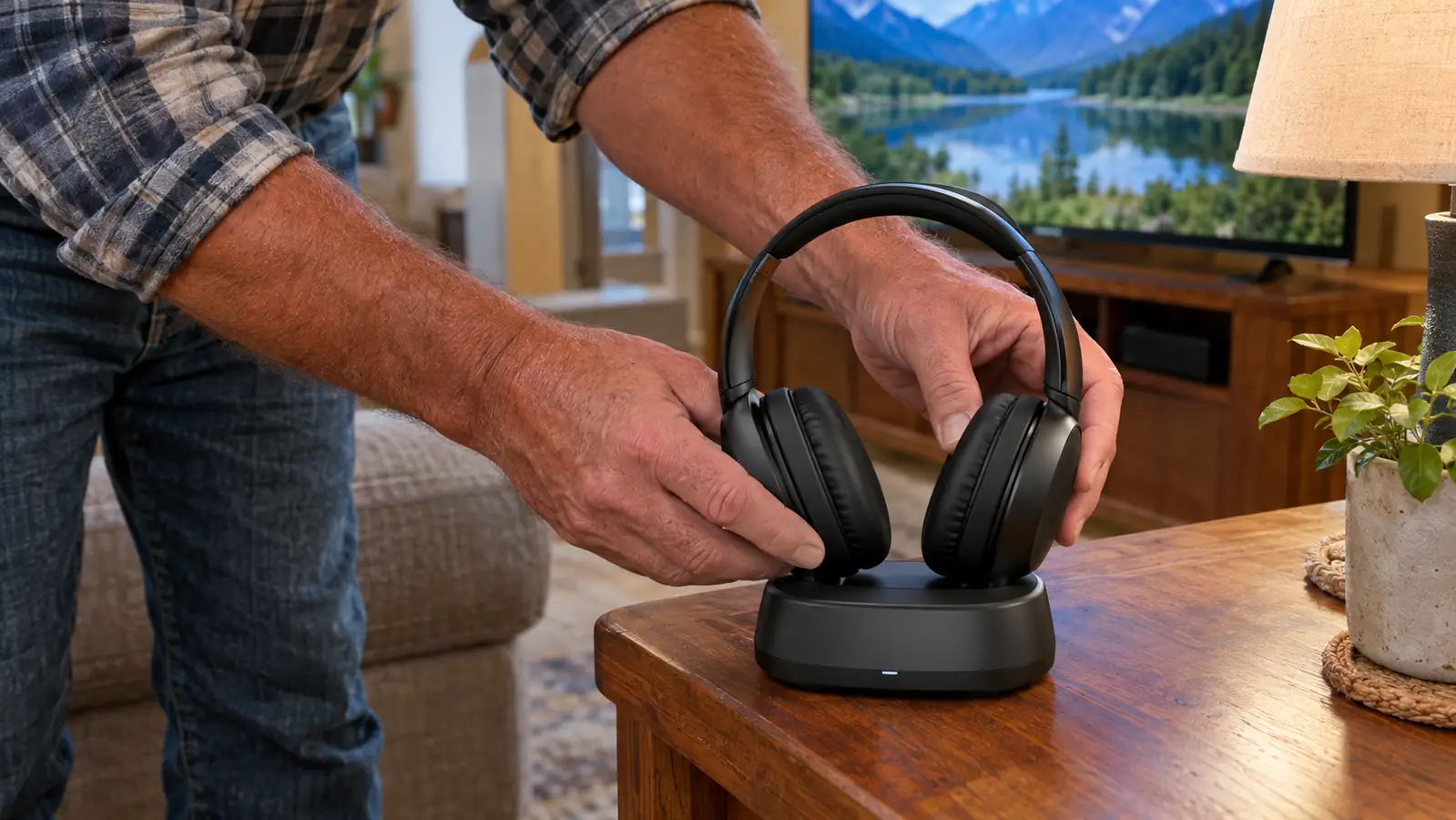
The Ensemble comes with a base unit that plugs into your TV and a pair of headphones. The base sits on the end table next to my recliner, and the headphones connect to it wirelessly. I can get up, walk to the kitchen, pour a glass of tea, and still hear the TV. That part works exactly the way the box says it does, and it's the reason I kept the system instead of sending it back.
I also tried it with the TV's built-in speakers off, which is how I use it now. The sound goes only to the headphones, so Joanne can read or doze on the couch without hearing the news. That turned out to be the biggest benefit, bigger than the volume fix. It means we can be in the same room doing different things and neither of us is annoyed.
What Nobody Tells You About Setup
The first surprise is that 'wireless' doesn't mean 'no wires at all.' The base unit needs to be connected to your TV with a cable. My TV has a headphone jack, so I used the included audio cable and it worked in about five minutes. If your TV only has an optical out, you'll use the optical cable and you'll need to change the TV's audio settings. That's not difficult, but it's the kind of step the quick-start guide treats like an afterthought.
The second surprise is the charging contacts. The headphones charge by sitting on the base, and the metal contacts have to line up. If you drop the headphones on the base at an angle, they might not charge. I learned this the night the headphones went dead twenty minutes into a ballgame. Now I make sure they click into place before I walk away. It's a small thing, but it's exactly the kind of small thing that makes a person curse a product in the dark.
Third, the included audio cable is short. If your TV is across the room from where you want to put the base, you'll need a longer cable. I used a six-foot cable I already had, and it solved the problem. That's not a complaint about the Ensemble, just a heads-up so you can plan before you start pulling your TV away from the wall.
Comfort: The Part That Depends on Your Head
Comfort is where the honest review gets complicated. The Ensemble headphones are not heavy, and the ear pads are soft enough for a couple of hours. But they clamp. I have a larger-than-average head, and after about ninety minutes I could feel the pressure building around my ears. Joanne tried them and didn't notice it. So the right answer is: it depends on your head.
The ear pads are the kind that go around your ears rather than sitting on them, which is good for long listening sessions. The headband has some padding, but not a lot. If you wear glasses all day, the clamp pressure can push the arms of your glasses into your head. I wear glasses only for reading, so it wasn't a problem for me, but I can see it being one for someone who wears them constantly.
There's also the heat. Any headphone traps some warmth, and the Ensemble is no exception. In the winter it was fine. In the summer, even with the air conditioning running, I wanted to take them off after a couple of innings. None of this is a dealbreaker, but it's the kind of thing you only learn by wearing them for real.
Sound Quality for Conversation, Not Concerts
The Avantree Ensemble is not trying to be a music headphone. It's a TV headphone, and it does the one job that matters: making dialogue clear. Voices come through clean and centered. I don't have to strain to hear what the news anchor is saying, and that was the whole point of buying it. Joanne noticed the difference the first night, and she's the one with normal hearing.
The sound stage is narrow. Explosions in a western don't have much rumble, and music doesn't have the depth you'd get from a good pair of stereo headphones. But for the evening news and a ballgame, that's fine. If you want to watch a concert film and feel like you're in the room, these are not the tool for that. Know what you're buying.
One thing that surprised me: the balance between my ears. My left ear is worse than my right, and the Ensemble doesn't have separate volume controls for each ear. That's a feature on some more expensive TV headphones, and I missed it. I could still hear everything, but if your hearing loss is very different between ears, you might want a model with left and right balance adjustment.
The Base Unit and the Range Question
The base unit does more than charge. It's also the transmitter, and it has a dial for the headphone volume. I liked having a physical volume dial instead of reaching up to press a button on the ear cup. The range is advertised as up to 100 meters in open space, which is marketing math. Through walls, in a brick ranch house, I got about thirty feet before the signal started to crackle.
That was enough for me. I could walk to the kitchen, pour a glass of iced tea, and still hear the TV. If I walked to the back bedroom, the sound dropped out. That's normal for this kind of system, but the box makes it sound like you'll have sound everywhere in the house. You won't, and it's better to know that now than to find out on the first night.
The base also has a charging light that's bright enough to notice in a dark living room. Joanne said it looked like a tiny blue nightlight. It's not a flaw, just a detail. I put a piece of tape over it and moved on. If you're sensitive to lights in the bedroom, you'll want to know about it before you buy.

Battery Life and the Charging Contacts
Battery life is decent, but it's not the all-day battery you might expect. I got about eight to ten hours of use before the headphones needed to go back on the base. That's enough for a full evening of TV, and usually enough for a whole day of baseball if I take a break at dinner. The headphones charge fully in about four hours, so a night on the base gets you through the next day.
The charging contacts are the weak point. If the headphones don't sit flush on the base, they don't charge. I had two mornings where I picked up the headphones and got a low-battery warning because I'd set them down crooked the night before. The fix is simple: line up the ear cups with the little guides and press down until you feel the click. But it's a step you have to remember, and the product page doesn't mention it.
There's also the auto-off feature, which is supposed to turn the headphones off when you set them on the base. Most of the time it works. But if the contacts aren't aligned, the headphones can stay on, and you'll find a dead battery the next time you reach for them. It happened to me twice in the first month. Once I learned the trick, it stopped happening.
What the Product Page Leaves Out
The buttons on the ear cups are easy to press by accident. I lost count of how many times I adjusted the headphones and paused the TV without meaning to. The power button and the volume buttons are all on the same side, and they're not recessed. You learn to pick the headphones up by the headband, but it takes a while, and it's the kind of design choice that makes a product feel less polished than it should.
The microphone feature, the one that lets you hear the room around you, is a nice idea but it's not a cure-all. It amplifies the TV sound and the room sound together, which can feel echoey. Joanne said it sounded like I was in a tin can. I stopped using that feature after the first week. If you need to hear the doorbell or a conversation in the kitchen, you're better off just taking one ear cup off.
And the manual is not great. It explains the basics, but it doesn't cover the optical audio settings or the charging contact issue. I ended up watching a video online to figure out the optical setup. That's not the end of the world, but it's the kind of thing that makes the difference between a good experience and a frustrating first hour.
What I'd Change in the Next Version
If Avantree ever makes a second version, I'd ask for three things. First, recess the buttons on the ear cups so they don't get pressed every time you adjust the headphones. Second, add a left and right balance control, even if it's a small dial on the base. Third, make the charging contacts a little more forgiving, maybe with a magnet that pulls the headphones into the right spot.
I'd also make the included audio cable longer. A six-foot cable should be in the box, not something you have to buy separately. And I'd write a manual that actually explains the optical audio settings, because that's where most people are going to get stuck.
None of those changes would make the Ensemble a different product. They'd just make it easier to live with. The core thing, the clear dialogue and the simple base unit, is already right.
What I Liked
- Clear, centered dialogue for TV and movies
- Simple base unit that also charges the headphones
- Wireless range is enough for kitchen trips
- No need to pair or connect Bluetooth every time
- Physical volume dial on the base
Where It Falls Short
- Ear pads clamp after about ninety minutes
- No separate left and right volume balance
- Charging contacts have to line up just right
- Auto-off can fail if headphones aren't seated
- Buttons on ear cups are easy to press by accident
The real test wasn't the specs. It was Joanne saying 'thank you' from the kitchen without me asking her to repeat it.
Who This Is For
This is for anyone who has stopped watching TV with the person they love because the volume is a battleground. If your spouse says 'it's too loud' and you say 'I can't hear it,' the Ensemble is a peace treaty. It's also for people who don't want to learn a new app or pair a Bluetooth device every time they sit down. You put the headphones on, they wake up, and the sound is there. That simplicity is the real selling point.
It's also for people who watch TV while someone else in the room wants quiet. Joanne can read on the couch while I watch a western, and neither of us is annoyed. That's a bigger deal than I expected. The Ensemble turned our living room from a compromise into a place where we can both do what we want.
Who Should Skip It
Skip it if you have very different hearing loss between your left and right ears and you know you need separate balance controls. The Ensemble doesn't have that, and no amount of fiddling with the base dial will fix it. You'd be better off with a model that offers left and right volume adjustment.
Skip it if you want to listen to music with real bass and depth. This is a TV headphone, not a music headphone. And if you wear glasses all day and your head is sensitive to pressure, try before you buy, or buy from somewhere with a good return policy. The clamp pressure is the most common complaint I can see in the ratings, and it's a real thing.
Still deciding? Start with the honest version.
The Avantree Ensemble is a good fix for the volume wars if you know its quirks. Check today's price and current ratings on Amazon, and see if it fits your living room.
Amazon Check Today's Price on Amazon →