
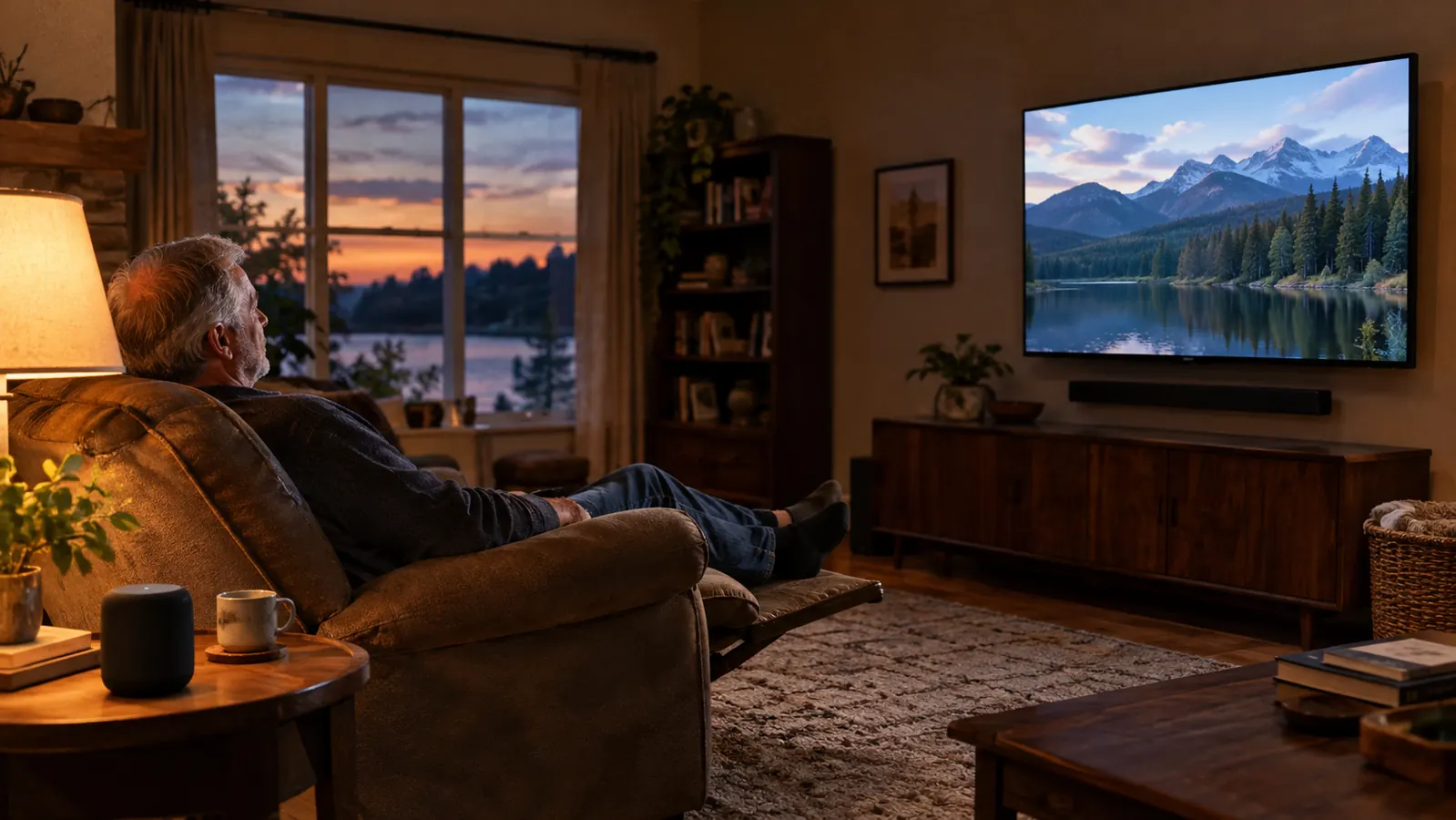
For a few years now, the question in our living room hasn't been about what to watch. It's been about how loud to play it. My wife Joanne has normal hearing, and I have the kind of high-frequency loss that comes with 34 years as a lineman. She would ask me to turn the TV down, I would turn it down, and then I would spend the whole program leaning forward and asking her what somebody just said. That back and forth wears on a marriage faster than you'd think. So when I came across the SIMOLIO wireless TV speaker for hard of hearing seniors, I figured it was worth a proper test. I've now had it in our living room for months, and I think I can tell you honestly what it does and what it doesn't.
Before I go further, one thing I want to be clear about: I'm not an audiologist. I'm a retired guy with a hearing test that shows mild to moderate loss in the high frequencies, worse in my left ear. What follows is one man's experience with a SIMOLIO speaker, not medical advice. If you haven't had your hearing checked in a while, start there. A speaker is a tool, not a cure.
The Quick Verdict
A wireless TV speaker that solves the volume wars in our house. It makes dialogue clearer without making the whole room shake, and it's simple enough that I set it up myself without reading the manual twice.
Amazon Check Today's Price →Tired of asking 'What did he say?' every night?
The SIMOLIO wireless TV speaker puts the dialogue where you can actually hear it, right beside your chair. See today's price on Amazon and whether it fits your setup.
Amazon Check Today's Price on Amazon →How I've Used It
Our setup is simple: a 55-inch TV in the living room, a recliner about 12 feet from the screen, and one shared remote. When I unboxed the SIMOLIO, the first thing I noticed was that it's compact. It doesn't look like a piece of medical equipment. It looks like a small speaker you'd be fine having out on a side table. I plugged the base into the TV's audio output with the included cable, set the speaker on the base to charge, and had sound coming out of it within ten minutes. I'm an old lineman, not a tech guy, and I did not have to call anyone for help.
The first night it was in the house, we watched the evening news with the TV volume where Joanne set it, which is 14 on our set. I kept the SIMOLIO at about a third of its own dial. For the first time in months I heard the anchors' names without asking her. The next night we tried a western, and that was the real test, because westerns mix quiet dialogue with wind, hoofbeats, and music all at once. I still missed a line here and there, but I stopped leaning forward. By the end of the first week, I noticed I had stopped reaching for the remote during quiet scenes. That was a habit I didn't realize I had until it was gone.
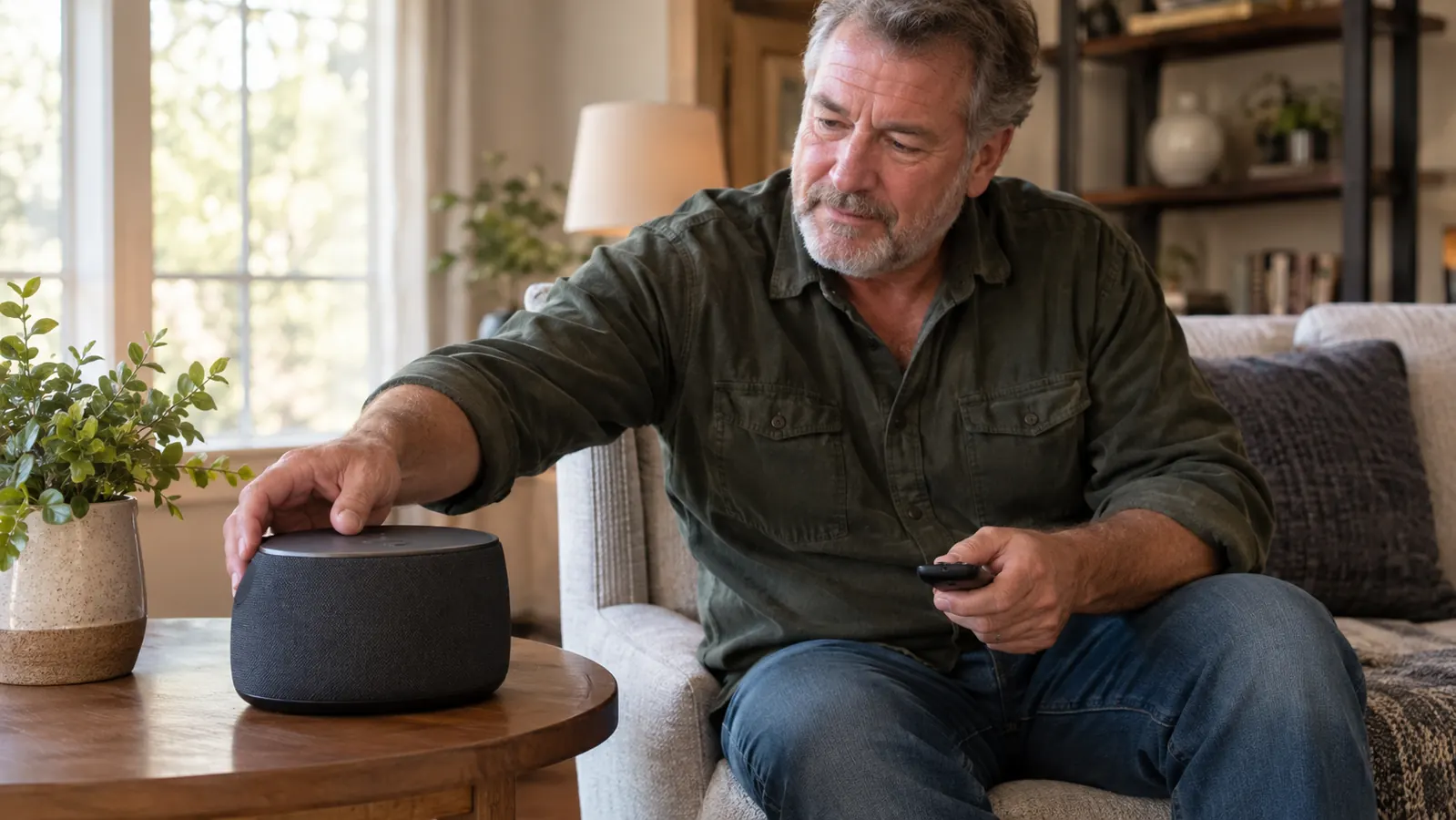
I've used it for the evening news, which is mostly talking heads, and for westerns and baseball, which have a lot of quiet dialogue and background noise mixed together. I've also used it for phone calls through Bluetooth. That took a little figuring out the first time, because the speaker was paired to the TV, and my phone had to take over the connection. Once I understood that, it became a handy way to take a call without holding the phone to my ear. Joanne has used it to listen to a show while I read in the same room. That last part matters more than I expected. She can hear her program clearly at a modest volume, and I can read in peace without the TV blasting. On a couple of nights she has fallen asleep to it in her chair, and I have just turned the speaker off and left her be.
The speaker sits on a side table next to my recliner, about two feet from my left ear, and it goes back on its base at the TV when the evening is over. That placement is the whole idea. Instead of the TV speakers firing across the room, the sound is right there. My hearing is worse in the left ear, so I aimed the speaker slightly toward that side. It made a bigger difference than I expected. I tried it in a couple of other spots first, on the shelf under the TV and on the coffee table, and both worked, but the side table was clearly best. The closer the speaker is to your ear, the less the room gets in the way. That sounds obvious, but it's the whole reason this kind of product exists.
What the SIMOLIO Actually Fixes
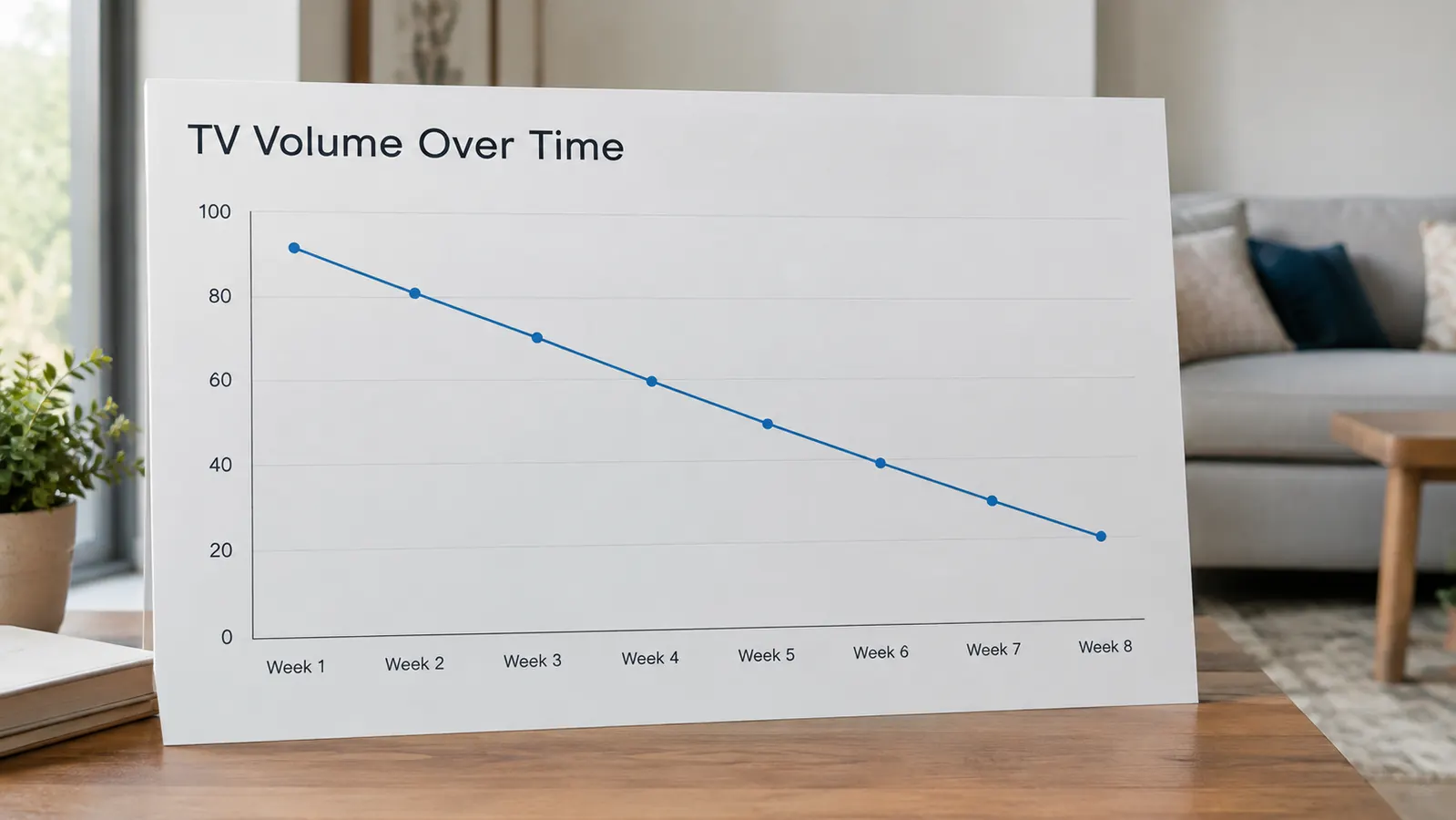
The first thing it fixes is the volume wars. Joanne used to ask me to turn the TV down several times a week. It got to the point where I would see her reach for the remote before she even said anything, and I would brace myself. Since the SIMOLIO has been in the living room, that has basically stopped. I can keep the TV at a level she finds comfortable, and the speaker delivers the dialogue to my chair at a level I can follow. We are both listening to the same program at the same volume, and neither of us is annoyed. The first time she said, 'I forgot you had it on,' I took that as a win. That alone was worth it.
The second thing it fixes is dialogue clarity. My hearing loss is mostly in the high frequencies, which is exactly where consonant sounds live. On the TV's built-in speakers, an actor would mumble and I'd miss half of what he said. Through the SIMOLIO, the same actor sounds clearer. It's not a cure-all. It's a speaker that puts the sound closer to my ear, and that's what my particular loss needed. I still miss a word now and then, but I'm not constantly leaning forward.
The third thing it fixes is the feeling of being left out. When we watch a movie with friends, I used to smile and nod a lot and hope nobody asked me what happened. With the SIMOLIO, I can actually follow the plot. One evening in particular sold me on this. It was a Thursday night in early March, and we were watching a baseball game. The announcers were talking over the crowd noise, and normally I would have given up and turned on the closed captioning. With the SIMOLIO, I followed the play-by-play without the captions. That same week, Joanne watched a drama with the subtitles off, something she had stopped doing because the volume I needed was too loud for her. We were in the same room, her at a normal volume, me with the speaker at my chair, and neither of us was annoyed. That is the whole product in one paragraph.
How It Performed Over Months of Use
I've had the SIMOLIO running for months now, through evening news, baseball games, westerns, and the occasional movie. The sound quality has stayed consistent. No crackling, no dropouts, no drift between the TV audio and the speaker. I did have to re-pair the Bluetooth once when I connected my phone, but that took about a minute and hasn't happened since. One thing that surprised me is how much I use the volume control on the speaker itself. The dial is right on top, so when a show is mixed louder or quieter than the last one, I can nudge it without hunting for the remote. After a while you learn the settings for your usual shows, the news at one level, baseball a notch higher, and you can set it before the opening credits finish.
Battery life is one of those things that sounds fine on paper and matters in real life. The speaker charges when it sits on its base, which is at the TV, so I make a habit of setting it back on the base when we're done for the night. Most evenings that's enough to keep it topped up. But I've also carried it out to the porch to listen to a ballgame while I did some work. One Saturday in April I had it outside for nearly four hours, and it was still going when the game went to commercial. When the battery does get low, the speaker gives a voice prompt. It's a spoken warning, not a loud beep that makes you jump. The first time it happened, I was in the kitchen and thought Joanne was talking to me. That's how unobtrusive it is. I learned to set it back on the base when I bring it inside, because the battery will run down overnight if you leave it on the table.
One thing I learned the hard way: the base needs to sit near the TV's audio output. The base is the transmitter and the charger, and it has to be plugged into the TV. Our TV is on a low cabinet, so the base sits right there behind the set, and the little cable that came in the box reaches fine. The speaker itself is wireless, which is the whole point. You can carry it across the room and it keeps working. But the base has to reach the TV, so if your TV is mounted high on the wall with nowhere to put the base, you'll want to think about that before you order. Measure the distance from the TV's audio output to the nearest flat surface, and make sure the included cable is long enough for your setup.
Joanne used to ask me to turn the TV down several times a week. Since the SIMOLIO has been in the living room, that has basically stopped.
The Tradeoffs You Should Know About
No product is perfect, and the SIMOLIO has a few things I'd want you to know before you order one. The first is that it's not a full home theater system. It's a speaker for one person or two people sitting close together. If you're expecting room-shaking surround sound, this isn't it. What it is, is a clear, focused stream of dialogue aimed at your chair.
The second tradeoff is the design. It's not ugly, but it's also not something you'd mistake for a high-end audio brand. It looks like what it is: a practical device made for people who need to hear the TV better. The controls are simple and readable, which I count as a feature at my age, but there's no getting around the fact that it's a piece of equipment sitting on your side table. If that bothers you, you might prefer a soundbar. But a soundbar doesn't do what this does. It doesn't put the sound right next to your ear, and it doesn't let Joanne keep the TV at a volume she can live with.
The third tradeoff is that the speaker is designed for one primary listener. Joanne can hear it fine when she's sitting next to me, but if she's in the kitchen, she relies on the TV's own volume. That's fine for us, because the whole point was to stop the volume wars, not to replace the TV speakers entirely. There's also the matter of the base. The SIMOLIO uses a base that plugs into the TV's audio output and doubles as the charger. The speaker only works when that base is powered. Ours sits on the cabinet behind the TV where nobody sees it, but it does mean one more thing plugged in and one more little box to keep track of. It hasn't given us any trouble, but I'd rather tell you about it than have you discover it after the box is open.
What I Liked
- Makes dialogue noticeably clearer for high-frequency hearing loss
- Ends the turn-it-down argument in our living room
- Simple setup, I did it myself in about ten minutes
- Compact and easy to move from room to room
- Bluetooth works well for phone calls and music
- Voice prompts instead of harsh beeps
Where It Falls Short
- Not a full home theater sound system
- Design is plain, not a showpiece
- Best for one primary listener, not a whole room
- Base placement depends on where your TV is set up
Who This Is For
The SIMOLIO wireless TV speaker is for anyone who has mild to moderate hearing loss and a spouse or family member who keeps asking them to turn the TV down. It's for the person who can hear fine in a quiet room but struggles when there's background music, or when an actor mumbles. It's for the person who is not ready for hearing aids, or who has hearing aids and wants an extra boost for TV. It's also for the person who is tired of closed captioning. I still use captions for some shows, but I no longer need them for the news or for baseball, and that's a real change. And it's for the spouse who just wants to watch a show without the volume at 11.
Who Should Skip It
If your hearing loss is severe, or if you haven't had a hearing test in years, talk to a professional before you spend money on a speaker. The SIMOLIO is a tool, not a cure. I say that as someone who has benefited from it every single night for months. If you're looking for room-filling sound for movie night, get a soundbar or a home theater system instead. And if you want something that disappears into your decor, this probably isn't it. It's a practical device that sits on a table and does its job. If you live alone and control the volume anyway, you may not need it either. The whole value here is that two people with different hearing can share one room.
Give your ears a break and your spouse some peace
Months in, the SIMOLIO is still earning its place on our side table. Check today's price on Amazon and see if it's the fix your living room needs.
Amazon Check Today's Price on Amazon →