
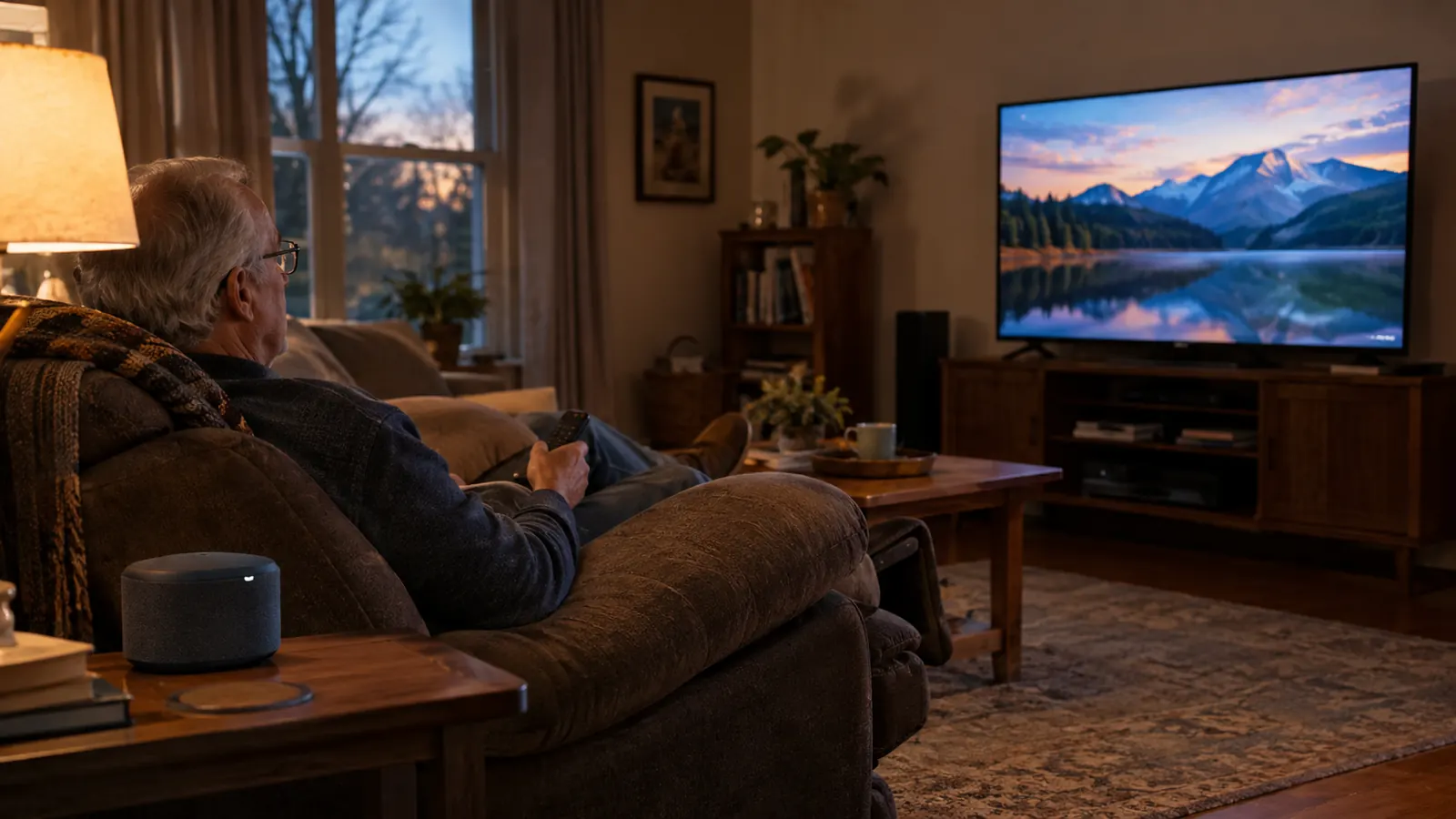
I spent three weeks with two very different ways to hear the TV better: the SIMOLIO wireless TV speaker and the ZVOX AV100. I am Walt Kesler, 69, a retired electrical lineman with mild to moderate high-frequency hearing loss in both ears, worse on the left. My wife Joanne has normal hearing, and she is the reason this comparison exists. She was tired of the volume being too loud for her and too quiet for me.
Here is the short answer. If you are the only person in the room who struggles with dialogue, the SIMOLIO is the better tool because it puts the sound right next to your ear without changing the volume for anyone else. If you and your spouse watch together and you want the whole room to sound clearer, the ZVOX does that better. Both have real tradeoffs, and I will walk you through them.
How I Tested Both
I set up each one in the same living room, on the same TV, at the same distance. Our TV is a 55-inch set on a stand, and my recliner sits about 12 feet from the screen. Joanne usually takes the couch. I used the same 6 o'clock news broadcast, the same Braves game, and the same western movie for both tests. I also tried them with the volume at a level Joanne found comfortable, which is the real test for anyone with hearing loss.
For the SIMOLIO, I placed the speaker on the side table next to my recliner and plugged the transmitter into the TV's audio output. For the ZVOX, I put the soundbar on the stand under the TV and connected it with the included audio cable. I adjusted each one's dialogue settings until they sounded best to me, then I left them alone for a few days and lived with them. That is the only way to judge a TV speaker. I started the SIMOLIO on a Tuesday night and the ZVOX the following Monday, keeping a small notebook on the end table. The first night with the SIMOLIO, I caught myself reaching for the TV remote out of habit before I remembered the speaker was on. The first night with the ZVOX, I kept reaching for a SIMOLIO remote that was not there anymore.
| SIMOLIO Wireless TV Speaker | ZVOX AV100 | |
|---|---|---|
| Placement | Sits beside your chair, at ear level | Sits on the TV stand under the screen |
| Wireless | Transmitter plugs into TV, speaker is cordless | Needs a cable from the TV to the soundbar |
| Dialogue clarity | Clear for the person sitting next to it | AccuVoice sharpens voices for every seat |
| Room sound | Personal volume, does not fill the room | Fills the room with TV sound |
| Bluetooth | Built in, streams from phone or tablet | Not available on the AV100 |
| Setup | About 10 minutes, no tools | About 10 minutes, no tools |
| Best for | One person with hearing loss | Couples or families watching together |
Where SIMOLIO Wins
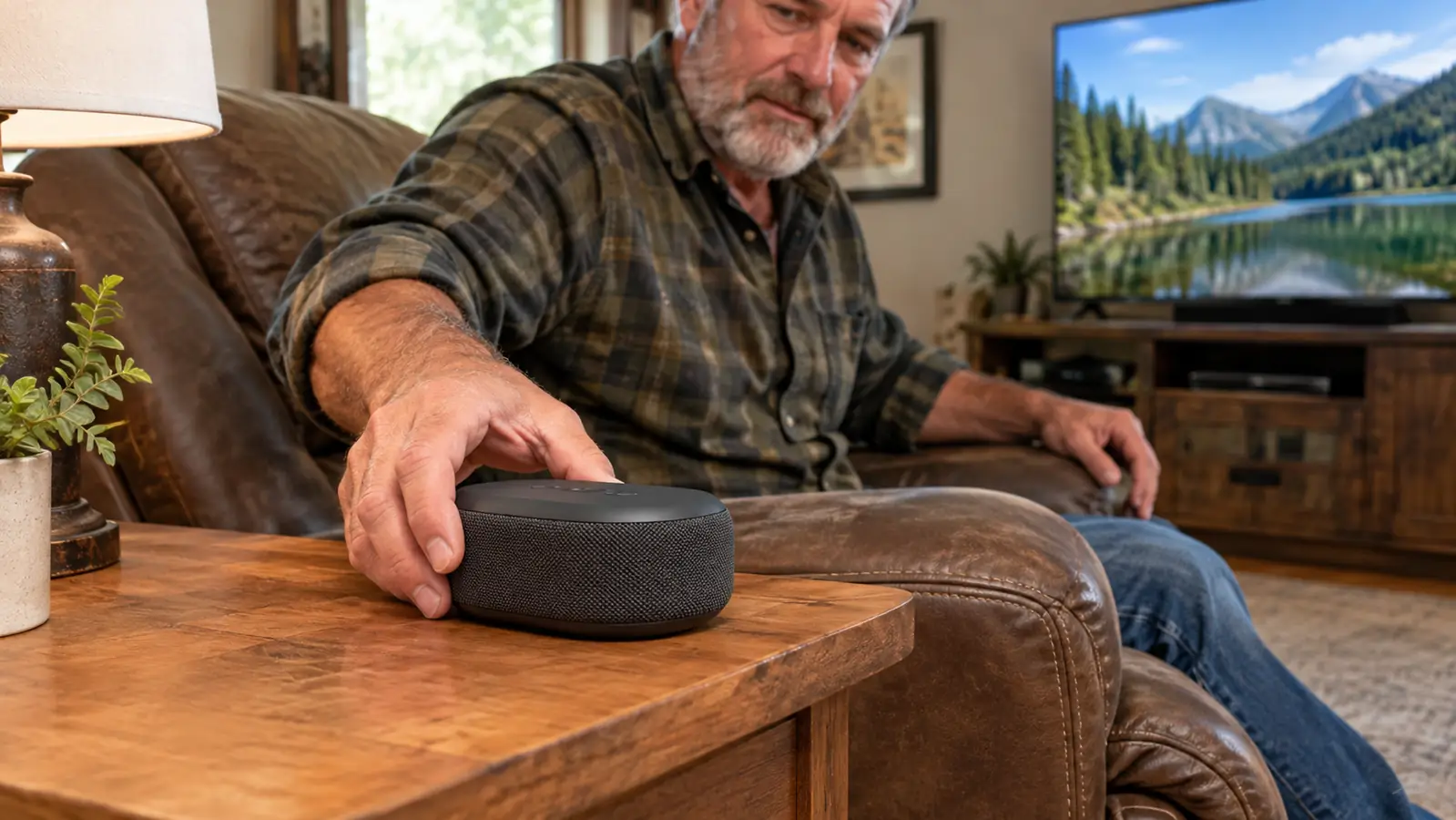
The SIMOLIO wins on the problem that started this whole search: my ears and Joanne's ears are different. With the SIMOLIO, I can turn up my own speaker without touching the TV volume. Joanne keeps the TV at a level she likes, and I get the dialogue at a level I need. That separation is the whole point of this kind of speaker, and it works. I watched a full ballgame with the TV at a normal volume and heard the announcers clearly for the first time in years. It was a Sunday night Braves game in early September, and Joanne fell asleep on the couch around the third inning. I turned the TV down to a murmur and left my speaker where it was. I heard every pitch call and every count on the broadcast without waking her once. That single evening convinced me the personal speaker was earning its place in the room.
It is also genuinely wireless. The transmitter plugs into the TV's audio output, and the speaker runs on its own power. I carried the speaker into the kitchen one afternoon just to see if the connection held, and it did. The Bluetooth input is another bonus. I can send audio from my tablet to the speaker when I want to watch something on a small screen. The ZVOX does not offer that.
Where ZVOX Wins
The ZVOX AV100 wins on dialogue clarity for the whole room. Its AccuVoice processing lifts voices out of the background music and sound effects, so every seat hears them more clearly. When Joanne and I watched the evening news together, the anchors sounded noticeably cleaner through the ZVOX. I did not have to lean forward or ask her to rewind. That is a real advantage when you are not watching alone. One night the weather segment ran with a radar graphic and a voiceover at the same time, which is exactly the kind of layered audio that trips me up. Through the ZVOX, the reporter's voice stayed in front of the music underneath it. Through the SIMOLIO, that same segment took me two tries to follow. I wrote that down in the notebook the same night.
It also sounds bigger. A soundbar in front of the TV spreads the sound across the room, which matters when you have people on the couch and in the recliner. The SIMOLIO is a personal speaker. It is not trying to be a home theater. If you want the whole living room to benefit from better TV sound, the ZVOX is the one that does that. The tradeoff is that you cannot set a separate volume for just your ears.
If you are the only one who cannot hear the TV, start here.
The SIMOLIO wireless TV speaker puts the dialogue right next to your chair and leaves the TV volume alone. Check today's price on Amazon and see if it fits your setup.
Amazon Check Today's Price on Amazon →The Setup Difference
Setup is where the two products really show their personality. The SIMOLIO is a two-piece system. You plug a small transmitter into the TV's audio output, then you plug the speaker into a wall outlet and pair them. The speaker is light enough to move around, and the pairing took me about two minutes. The only catch is that the transmitter needs to be near the TV, which is usually not a problem.
The ZVOX is a single box. You put it under the TV, plug in the power cord, and run the included audio cable from the TV to the soundbar. That cable is the main difference. If your TV is mounted on the wall, you will have to hide that cable or live with it. The ZVOX also has a separate wireless subwoofer in some versions, but the AV100 I tested is a simple two-channel soundbar.
What Nobody Mentions
Nobody mentions that these two products are solving different problems. A soundbar like the ZVOX makes the TV sound better for everyone in the room. A personal speaker like the SIMOLIO makes the TV sound better for exactly one person. They look like they should be competitors, but they are really answering two different questions. Once you know which question you are asking, the choice gets easier.
The other thing nobody mentions is that your spouse's ears matter as much as yours. Joanne does not have hearing loss, but she still wants to hear the TV clearly. With the SIMOLIO, she hears the TV at her level and I hear it at mine. With the ZVOX, we both hear the same improved sound. Neither is wrong. It just depends on whether you watch alone or together.

The Volume Question
The volume question is the one that makes or breaks these products. With the SIMOLIO, the TV volume stays where Joanne wants it, and I adjust the speaker next to my chair. That means she can watch at a normal level and I can still hear the whispers in a western. The scene I used for the test was from an old movie where two men talk low over a campfire. On the TV alone, I missed half of what they said. With the SIMOLIO speaker at about three quarters of its range, I caught every word while Joanne read her book across the room. I marked the volume setting in the notebook so I could reproduce it the next night. That is the exact situation that used to start arguments in our house.
With the ZVOX, the volume is shared. The soundbar makes the TV louder and clearer for both of us, but it does not give me a separate control. If I need more volume, Joanne hears more volume too. For us, that was the biggest difference. It is not a flaw in the ZVOX. It is just a different design. You have to decide which tradeoff fits your marriage.
What About the Remote?
The remote is a small thing, but it matters at my age. The SIMOLIO has a simple remote with a volume rocker and a mute button. It does not try to control the TV, which means I do not have to point it at anything specific. The ZVOX remote also controls the TV volume if you set it up that way, which is handy, but it adds a layer of programming. I am not a fan of programming remotes, so the SIMOLIO won that round.
The other remote difference is the buttons. The SIMOLIO remote has large, well-spaced buttons that are easy to find in the dark. The ZVOX remote is smaller and the buttons are closer together. If you have big fingers or low light, that matters. It is not the reason to choose one speaker over the other, but it is the kind of detail you notice after a week.
What I Would Change
I would change one thing about the SIMOLIO: the speaker is designed for one person. If Joanne wants to hear better, she has to sit close to it or we need a second speaker. The company does sell a version with two speakers, but the single-speaker model I tested is a one-person tool. That is fine for my situation, but it is worth knowing before you buy.
I would change one thing about the ZVOX: it needs a cable. In our living room, the TV sits on a stand, so the cable was easy to hide. If your TV is mounted, you will have to run the cable down the wall or use a wireless kit. That is not a dealbreaker, but it is extra work. The SIMOLIO avoids that entirely with its wireless transmitter.
Who Should Buy Which
Buy the SIMOLIO if you are the only person in the room who struggles with dialogue. It works when the TV volume is comfortable for your spouse. It works when you watch alone and want to keep the house quiet. It works if you want to stream audio from a phone or tablet. It is the more flexible of the two for a single listener.
Buy the ZVOX if you and your spouse watch everything together and you both want the TV to sound better. It is also the better pick if you have a dedicated TV room and do not mind a soundbar sitting on the stand. The tradeoff is that it does not give you a separate personal volume. You are both listening to the same sound, just a clearer version of it.
If you are not sure which situation you are in, start with the SIMOLIO. It is the easier experiment, it is easier to move around, and it solves the specific problem of one pair of ears being different from another. If you find you want the whole room to sound better, the ZVOX will still be there. That is the honest way to look at it.
The Bottom Line
After three weeks of switching back and forth, I keep coming back to the same conclusion. The SIMOLIO is the better answer for my house because my ears and Joanne's ears are different. We can watch together without arguing about the volume. The ZVOX is the better answer for a house where everyone wants the TV to sound better together. Both are honest products. They just solve different problems.
If you are still reading this, you probably know which situation you are in. If you are the only one who cannot hear, buy the SIMOLIO. If you want the whole room to sound better, buy the ZVOX. And if you are not sure, start with the SIMOLIO because it is the easier experiment. I have been using mine for three weeks and I have no plans to send it back.
Still deciding? Try the SIMOLIO first.
It fixes the exact problem of one person's hearing being different from everyone else's. Check today's price on Amazon.
Amazon Check Today's Price on Amazon →