
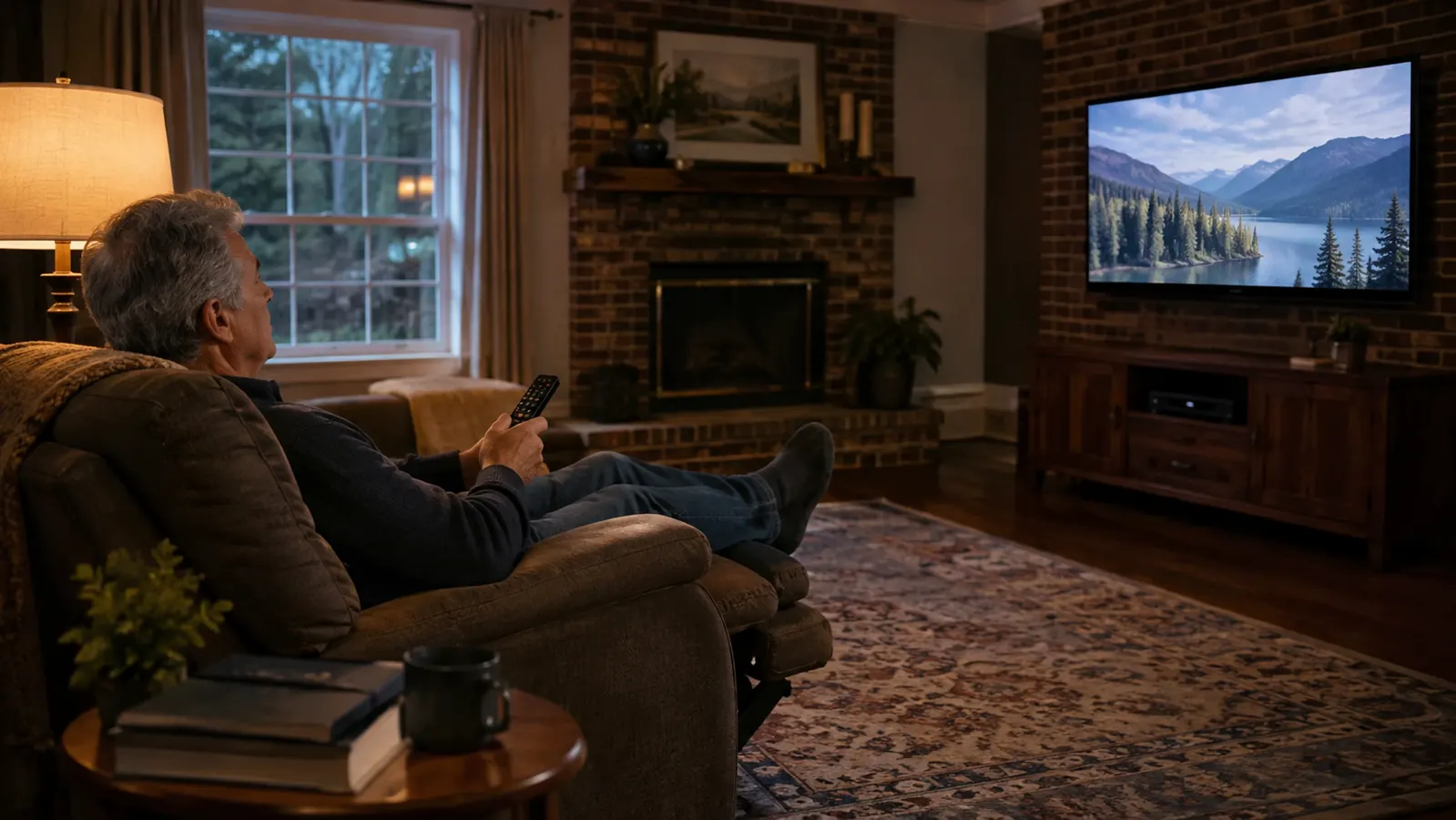
The scene is probably familiar. I'm in my recliner, twelve feet from the TV, the volume is high enough that Joanne has left the room, and I still cannot tell you what the news anchor just said. I've tried the closed captions. I've tried cranking the treble. I've tried moving my chair closer, which my back hated. None of it fixed the actual problem, because the problem was never how loud the TV was. The problem was that dialogue lives in the same frequency range my ears quit hearing years ago.
That's the honest place to start this review. The ZVOX AV100 is not a hearing aid. It is a compact soundbar built around one job: making voices clearer. I've had one in our living room for six weeks now, and it has changed how we watch TV in ways I did not expect, both good and a little odd. I bought this one myself, no review unit, because that's the only way I trust a product like this. What follows is what it actually does, and what it does not do, from a guy who tests things before he trusts them.
The Quick Verdict
The best fix I've found for muffled TV dialogue, as long as you understand it's a speaker, not a hearing aid.
Amazon Check Today's Price →If you're replaying scenes to catch the words, read this.
The AV100 is built for exactly this problem: voices that get lost in the mix. Six weeks in, it's the first fix that has actually worked in our living room.
Amazon Check Today's Price on Amazon →How I've Used It
Setup took one evening, and most of that was me reading the manual twice because that's how I am. The bar is compact, about seventeen inches wide, which fits on our TV stand without crowding anything. The box includes the cables you need for most TVs, an optical cable and the red-and-white RCA kind. Our TV has an optical output, so I plugged that in, plugged the bar into power, and it worked on the first try.
One thing the manual does not emphasize enough: on a lot of TVs you have to go into the settings and turn the TV's own speakers off, or the TV and the soundbar play at the same time and you get an echo. That took me a few minutes to find. If you buy this, check that first, because it's the difference between 'this sounds great' and 'why does everything have a tail on it.'
Since then, it's been the everyday setup. Evening news, a western, most of a baseball season. The remote has big, widely spaced buttons, which matters when you're 69 and the remote is on the arm of the recliner. It works over line of sight, so the bar needs to sit where the remote can see it. Ours is out in the open on the stand, so that's fine.
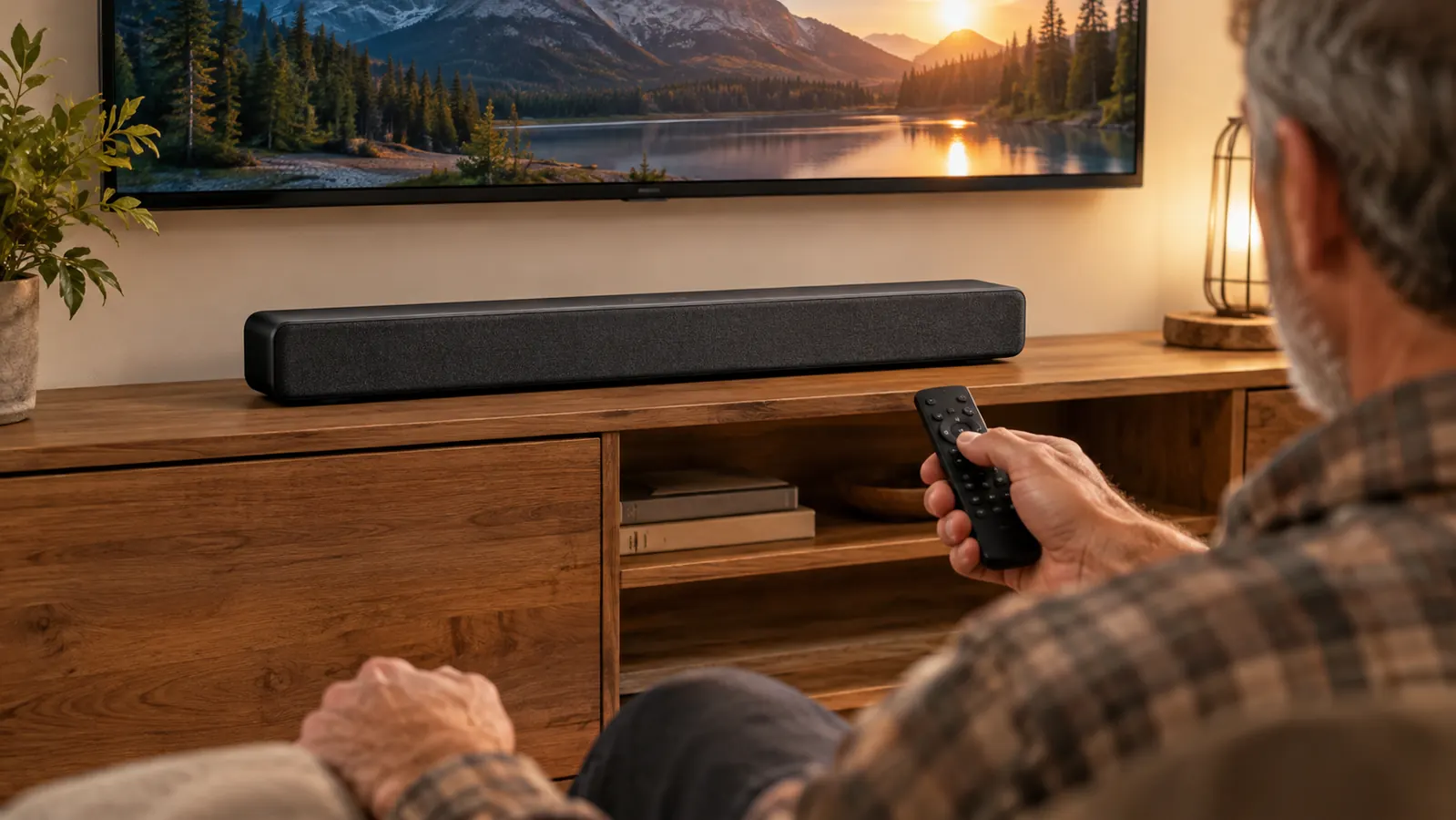
The bar sits on the stand under the TV, not much taller than a paperback stood on end. It does not look like a serious piece of audio equipment, and that's fine with me. It looks like it belongs in a living room. The connections are simple too: one optical input, one auxiliary input, and Bluetooth for streaming from a phone. If you have more than one thing plugged into the TV, you switch sources on the TV and the bar follows along. I was worried about that part, and it turned out to be a non-issue.
What the AccuVoice Boost Actually Does
The whole point of this bar is AccuVoice, ZVOX's name for its voice boost. It is not magic. It is a tone control with a brain. Speech lives in the higher part of the frequency range, and that is exactly the part my ears lost first. The boost lifts those frequencies so the words come through the way they did when I was forty. It's worth knowing that ZVOX was started by a man with hearing loss himself. You can feel it in the design: big buttons, simple setup, no features that need a manual.
There are six levels. Level one and two are subtle, barely there. Three and four are where I live day to day. Five and six are for bad days, or for badly mixed shows, and they work, but they sound artificial. Everything gets a little processed, a little forward. The first time I tried level six, Joanne said the voices sounded like they were standing in the room with us, which is not as pleasant as it sounds. Most people land in the middle, and the middle is where the boost sounds best.
There's also a setting ZVOX calls output leveling, which evens out the loud and soft parts of the mix. Explosions get pulled down, whispers get pulled up. That matters more than I expected, because a lot of the strain with TV isn't just that dialogue is quiet. It's that the show jumps from a whisper to a roar and back again.
The tradeoff is honest: music and sound effects do not sound as natural with the boost on. This is not a music bar. It is a dialogue bar. The boost helps most on shows where the voices are recorded cleanly: news, sports, most westerns. It helps least where the director buried the dialogue under music on purpose. You'll figure out which is which in the first week.
Where It Falls Short
The first thing nobody tells you: it will not fix a badly mixed show completely. Some streaming programs mix the dialogue low on purpose, under music and effects, and no speaker can fully undo that. The AV100 gets you most of the way there. I still reach for the captions on those shows, and that's not the bar's fault.
Second, this is not a home theater. It's a compact bar with a modest built-in subwoofer. It will not shake the walls, and it will not give you surround sound. In a big room, it can run out of headroom. Our living room is a normal size and it's fine. If your room is bigger than a typical living room, or you like to sit far from the screen, you may want a larger ZVOX model with more power. If you want movie theater rumble, this is the wrong tool.
Third, the remote needs line of sight. If you hide the bar in a cabinet, the remote will not reach it. That's true of most soundbars, but it's worth saying because the AV100 is small enough that you might be tempted to tuck it away. One related note: the Bluetooth is for streaming from a phone or tablet, not for the TV. You'll connect the TV with the optical or auxiliary cable. Know that going in and you won't be confused.
Fourth, and this is the one I want to be careful about: it takes about a week to get used to. The first few nights, everything sounds different, and different can read as wrong. Your ears adapt. By week two, I stopped noticing the processing and just heard the words. Give it that week before you decide.
The Part Nobody Tells You: The Spouse
Here's what surprised me, and it's the reason I'd buy this again. The real problem in our house was never just my ears. It was that the TV had to be loud enough for me, which meant it was too loud for Joanne. She'd leave the room during the news. She'd ask me to turn it down, and I'd turn it down, and then I couldn't hear, and we'd both be annoyed.
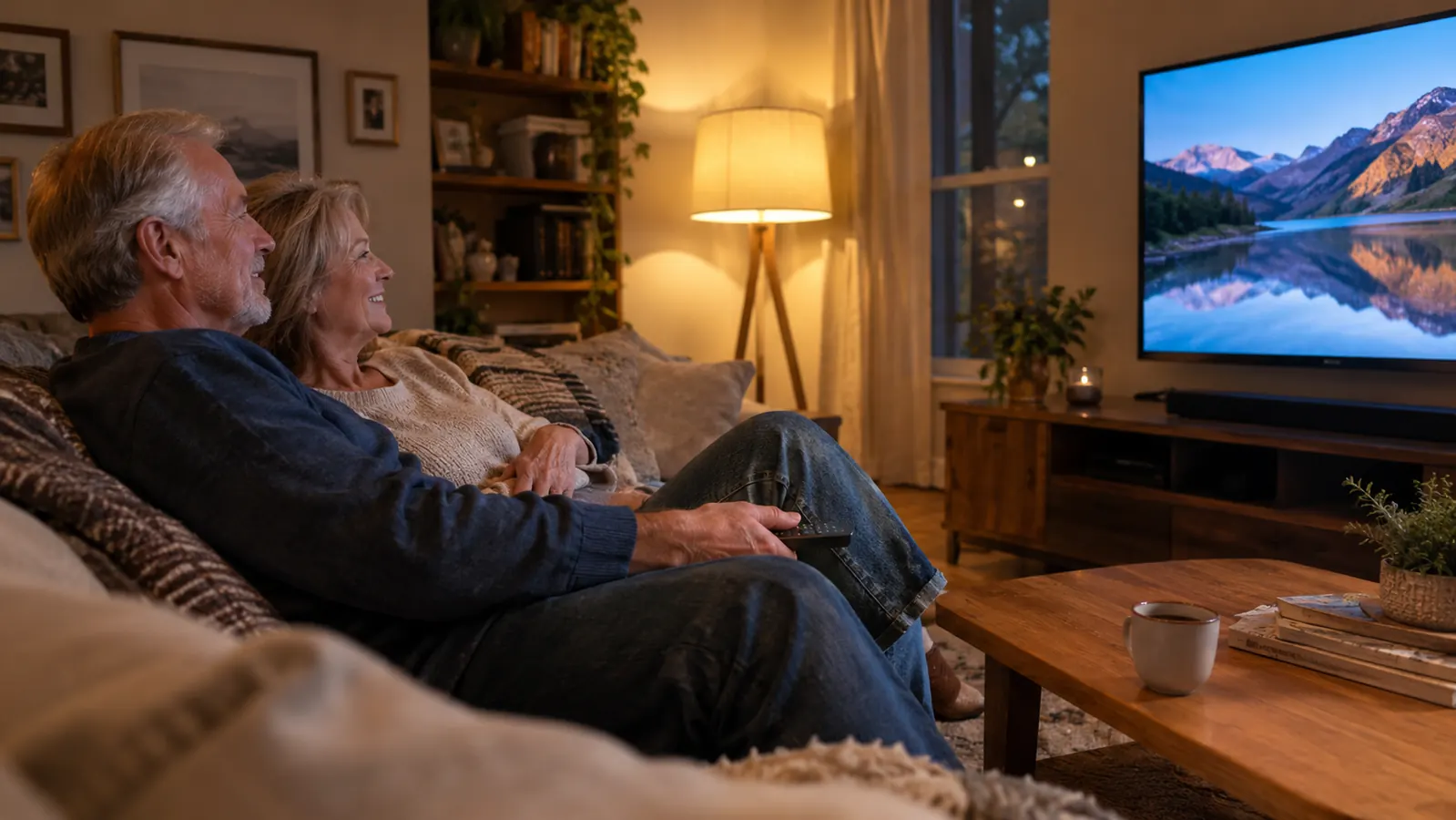
The AV100 fixed that in a way I didn't expect. Because the voice boost works on the frequencies I need, the overall volume can stay at a level Joanne is comfortable with. We watch at a normal volume now. She stays in the room. I hear the words. The volume wars ended. That's not a small thing after thirty years of the same argument.
Joanne says the sound is a little 'forward,' which is her word for the boost making voices stand out. She doesn't mind it. She minds the TV being loud a lot more than she minds the sound being forward. That trade, she tells me, is a good one.
The proof, for me: Joanne hasn't asked me to turn the TV down in six weeks. That has never happened in our whole marriage. I don't know how to put a star rating on that, but it's the number that matters.
Joanne hasn't asked me to turn the TV down in six weeks. That has never happened in our whole marriage.
What Six Weeks Taught Me
The honest verdict after six weeks: this is a tool, and it's a good one, but it has a narrower job than the box lets on. It makes voices clearer. That's it. It does not make your hearing better, it does not make every show sound great, and it does not replace getting your ears checked. I'd rather have a product that does one job well than one that does five jobs poorly, and this one knows its job. Once you accept that, it's hard to be disappointed.
I also learned that the boost level is not a set-and-forget thing. Some nights I watch at level three. On a bad day, or with a show that's mixed badly, I bump it to five. The remote makes that easy, which is exactly why the big buttons matter. You will probably fiddle with it for the first couple of weeks, then settle into two or three settings you trust.
One small thing I noticed: I use the captions a lot less than I did. Not never. Some shows still need them, and Joanne likes them for the British mysteries where everyone mumbles on purpose. But the reflex of turning them on the moment a show starts, that's mostly gone.
And I learned that the real test of a product like this is whether you stop thinking about it. By week three, I stopped thinking about the soundbar and just watched the show. That's the highest compliment I can give it.
Alternatives I Considered
Before I bought the AV100, I tried the obvious things. TV headphones work, but they isolate you. I'd be in my own little world and Joanne would be in hers, and that's not why we watch TV together. Closed captions help, and I still use them sometimes, but they pull your eyes off the picture.
I also tried the wireless TV headphones that come with a base station you plug into the TV. They worked, but the sound in my head felt separate from the picture, and the headset got uncomfortable by the second hour. Worse, they only helped me. Joanne was still listening to the TV speakers, so we were back to two different volumes in one room.
I also looked at regular soundbars, the kind people buy for movie sound. They're fine for bass and effects, but most of them do nothing for voices. The other name people bring up is the Bose TV Speaker. It's a good speaker, and it has a dialogue mode. I chose the AV100 because its voice boost goes further and the output leveling is built in. For my ears, that made the difference.
And the honest biggest alternative: a hearing test and hearing aids. I'm a user, not an audiologist, and I'll say it plainly. If you're straining even with the boost at level six, or if you're missing conversation at the dinner table too, go get your hearing checked. The AV100 fixes the TV. It does not fix your ears, and nothing should pretend otherwise.
What I Liked
- The voice boost works on the frequencies that actually matter for dialogue
- Compact enough to fit on a normal TV stand without taking over
- Cables in the box, setup in an evening
- Remote with big, widely spaced buttons
- Output leveling evens out the loud and soft parts of a show
- The spouse test: we watch at a normal volume together again
Where It Falls Short
- Music and effects sound processed at the higher boost levels
- It won't fully fix shows that are mixed badly on purpose
- Not a home theater bar: modest bass, no surround
- Remote needs line of sight, so don't hide the bar
- A speaker, not a hearing aid, can't fix your ears
Who This Is For
Buy the AV100 if you have mild to moderate high-frequency hearing loss and TV dialogue is your main complaint. If you're the spouse who's tired of the volume wars. If you want a fix you can set up in an evening without a sound system degree. If you're not ready for hearing aids but you're ready to hear the news again. If you're the one who reaches for the remote to rewind, this is for you. If you're the one who leaves the room, this is for you too. It's also a reasonable bridge: it kept us sane while I got my hearing checked.
Who Should Skip It
Skip it if your hearing loss is severe, because a speaker is not the fix for that; go see a professional first. Skip it if you want a home theater bar with surround and deep bass, because this isn't that. Skip it if your TV has no audio output at all and you don't want to mess with adapters. And skip it if the problem is music, not voices. This bar is a specialist, and it's honest about that. One piece of advice from experience: don't buy this as a surprise for a spouse who hasn't complained. The person who needs the boost has to want it, or it just becomes another thing in the living room that gets blamed for how the TV sounds.
If your living room sounds like mine did, this is the fix.
The AV100 does one job and does it well: it puts the words back in the picture. If that's your fight, it's worth trying in your own living room.
Amazon Check Today's Price on Amazon →