

Restaurants used to be the place I went quiet. Joanne and I would sit down with friends at a busy diner after church, the room would fill up with plates and chatter and the espresso machine, and within ten minutes I was nodding along to sentences I had only caught half of. I spent thirty four years around line trucks and chainsaws, and the high voices and soft consonants are the first things I lose. The Williams Sound Pocketalker Ultra is the tool that changed those meals for me, but it only works well when you set it up and use it the right way. This guide walks through exactly how I do it.
A quick word before the steps. I am a retired lineman, not an audiologist. The Pocketalker is a personal sound amplifier, a small box with a microphone and a volume knob that feeds a pair of headphones or earbuds. It is not a prescription hearing aid and it does not treat hearing loss. If you are struggling to follow people, a hearing test with a professional is the right first move. What I can tell you is how this little amplifier behaves in the noisy rooms where most of us actually live.
The amplifier I keep in my jacket pocket
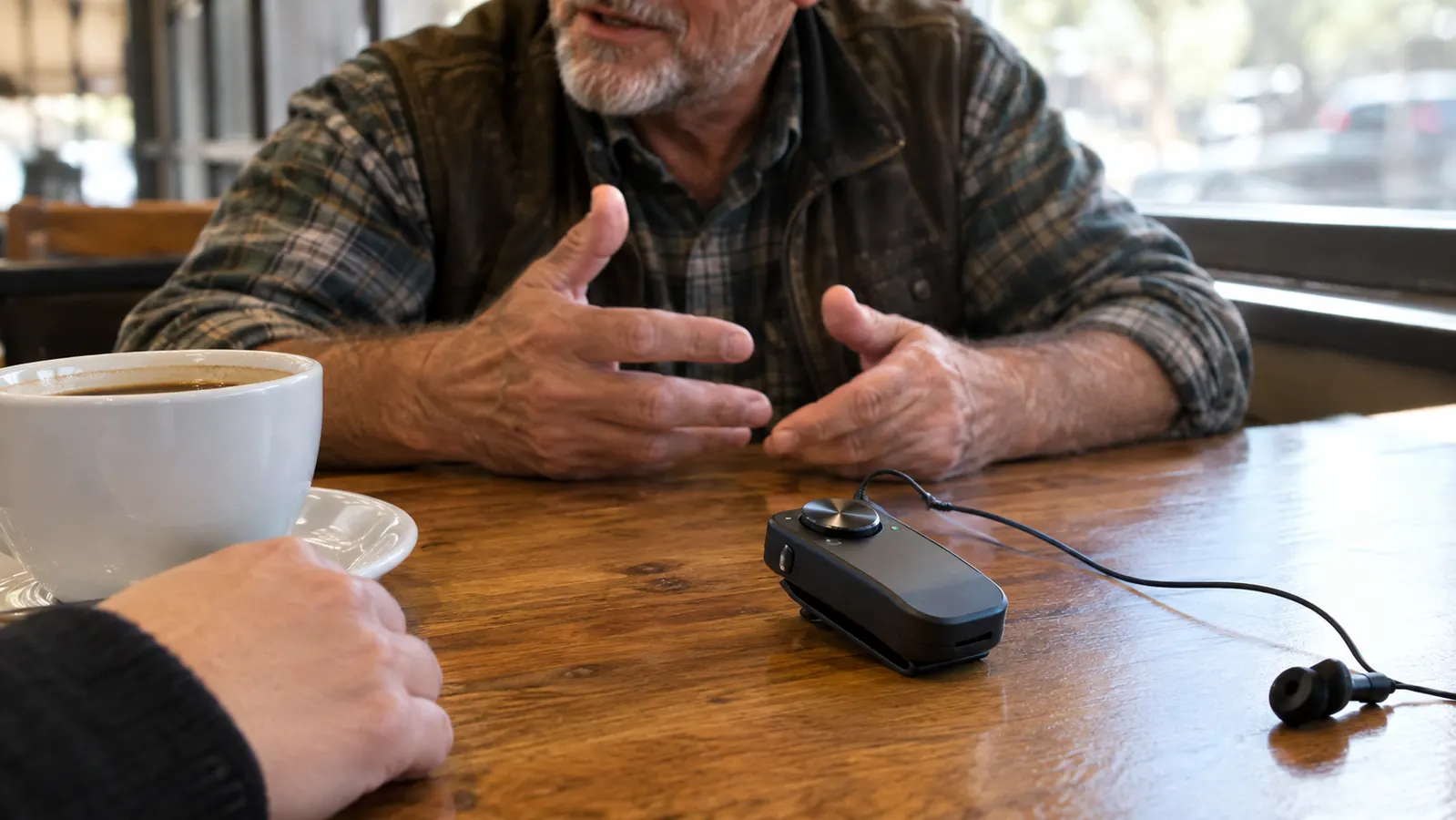
The Williams Sound Pocketalker Ultra is a simple personal amplifier with one big volume knob, a tone control and a clip-on microphone option. It is the thing that got me back into the conversation at a crowded table.
Amazon Check Today's Price on Amazon →Step 1: Start in a quiet room so you learn what normal sounds like
The biggest mistake I made the first week was taking the Pocketalker straight to a loud restaurant. Everything came at me at once, the clatter, the kitchen, the table behind us, and I decided the thing was useless. It was not useless. I just had no idea what it was supposed to sound like.
So start at home. Sit at the kitchen table with your spouse or a friend, put the earbuds in, turn the volume knob all the way down, and switch it on. Then slowly turn it up while they talk in a normal voice. Stop at the point where their words are clear and comfortable, not loud. That is your baseline. On my unit that sits a little below the halfway mark, but everybody is different, so trust your own ears rather than a number.
Spend two or three evenings this way. Listen to the TV across the room, the refrigerator humming, a spoon on a plate. You will start to recognize which sounds the Pocketalker lifts and which ones it leaves alone, and that knowledge is what lets you make good adjustments later when the room is chaotic.
Step 2: Use the tone control to cut the rumble
Most of the noise in a busy room is low and heavy: chairs dragging, air handlers, traffic outside, the general roar of a crowd. Speech, especially the consonants that make words understandable, lives higher up. The Pocketalker Ultra has a tone control, and in a noisy room I turn it toward the higher setting so the rumble drops back and voices come forward.
Try it at home first with the TV on as background noise. Turn the tone control from one end to the other while someone talks to you, and notice the point where their voice gets crisper without turning tinny. That is usually where I leave it for restaurants and family gatherings. In a quiet doctor's office I may turn it back toward the middle, because there is less rumble to fight.
This one adjustment did more for me than any amount of volume. Turning the volume up in a loud room just makes the whole mess louder. Shaping the tone is what separates the person across the table from everything else.
Step 3: Get the microphone closer to the person you want to hear
Here is the part that matters most, and it is just physics. A microphone hears what is closest to it. If the Pocketalker sits in my shirt pocket and my friend is across a wide table, the microphone is hearing the plates and the people behind me about as well as it hears him. Move the microphone toward the talker and the balance swings in your favor.
In practice I do one of three things. At a small table I set the unit on the table pointed at whoever is speaking, and slide it toward the next person when the conversation moves. For one-on-one talks, like with my grandson in a busy coffee shop, I use an extension cord and the clip microphone so he can clip it to his collar. And in a car, I hold the Pocketalker up near the dashboard so Joanne's voice reaches it before the road noise does.
People are almost always happy to help once you explain. I just say, this little microphone helps me hear you, would you mind if I set it near you. Nobody has ever said no, and a few folks have asked where I got it.
Turning the volume up in a loud room just makes the whole mess louder. Moving the microphone closer is what actually works.
Step 4: Pick your seat before you sit down
Where you sit can matter as much as what you wear. When Joanne and I walk into a restaurant now, I ask for a booth or a table along a wall, away from the kitchen doors and the front entrance. A wall behind me blocks some of the noise coming from that direction, and a booth's high back does even more.
I also try to sit where I can see the faces of the people I am talking to, with the light falling on them rather than behind them. Even without meaning to, all of us read lips a little, and a well lit face fills in the gaps the Pocketalker cannot. Sitting with a bright window behind your friend turns their face into a shadow, and you lose that help.
At family gatherings, I park myself at the end of the table instead of the middle. In the middle I have conversations on both sides competing for the microphone. At the end, most of the talk comes from one direction and I can point the Pocketalker that way.

Step 5: Keep the volume as low as you can
It is tempting to keep turning the knob when the room gets louder. I learned not to. The goal is to hear words clearly, not to make everything loud, and pushing an amplifier hard in a noisy place sends a lot of sound into your ears for a long time. That is not good for the hearing you still have.
My habit now is to set the volume at the lowest level where I can follow the person nearest me, then fix problems with the tone control and the microphone position before I touch the volume again. If I find myself reaching for the knob over and over, that is my signal to move the microphone or change seats, not to crank it.
I also take short breaks. During a long dinner I will switch the Pocketalker off for a few minutes while everybody is busy eating, then switch it back on when the talking picks up. My ears feel less tired at the end of the evening when I do that.
Step 6: Choose earphones that fit the situation
The Pocketalker Ultra works with the earbuds that come with it and with standard headphones that plug into the jack. Each has a place. Earbuds are discreet, and in a restaurant I prefer them because they sit quietly and do not announce themselves. Over-ear headphones block more of the room noise on their own, which helps in really loud places like a grandchild's basketball game, but they are bulkier.
Whatever you use, make sure it fits well. A loose earbud lets the room leak in around it and forces you to turn the volume up. If the included earbuds do not seat comfortably in your ears, try a different size of tip or a lightweight headphone before you decide the amplifier is not working.
Step 7: Look after the batteries and the cord
Nothing ruins a dinner faster than a dead amplifier halfway through the meal. The Pocketalker Ultra runs on AAA batteries, and I keep a spare pair in the same jacket pocket. I swap them at the first sign of crackle or weak sound rather than waiting for them to quit completely.
The cords take a beating in a pocket, too. I wrap the earbud cord loosely, never tight around the unit, and I keep the whole kit in a small soft pouch so it does not get tangled with keys. A cord that has been kinked over and over can cut in and out, and it is easy to blame the amplifier for a problem that is really a worn cable.
What Else Helps
The Pocketalker is only part of the answer. A few habits have made just as big a difference for me. I tell the people I am with that I have trouble hearing in noisy rooms. That one sentence takes the pressure off, and people naturally turn toward me and slow down a little. I ask people to rephrase rather than repeat; if I missed a sentence the first time, hearing the same words again often does not help, but different words usually do.
I go to restaurants a little earlier or later than the rush when we have the choice. A diner at four in the afternoon is a completely different room from the same diner at six. And when a place is simply too loud, with music blasting and hard floors everywhere, I have learned to suggest we step outside or move to a quieter corner instead of straining through it.
Finally, I keep my expectations honest. The Pocketalker Ultra does not give me the hearing I had at thirty. What it does is turn a lot of half caught sentences into whole ones, and in a busy room that is the difference between being part of the conversation and sitting it out. If your hearing has changed suddenly, or you notice it mostly in one ear, please see a doctor or an audiologist, because those are not things an amplifier should be covering up.
Set it up at home, shape the tone, move the microphone close, keep the volume modest, and choose your seat with some thought. Do those things and a personal amplifier like this one can make those noisy rooms a lot more welcoming again.
Ready to try it at your next family dinner?
The Williams Sound Pocketalker Ultra is simple enough to learn in an evening and small enough to carry everywhere. Check the current price and the latest reviews on Amazon.
Amazon See Today's Price on Amazon →