

I will be honest with you right up front: the Williams Sound Pocketalker Ultra did not fix my hearing, and it will not fix yours. No small box with earbuds can do that, and anyone who tells you different is selling something. What it did do is make the evening news watchable again, and it let me sit through a whole baseball game without asking Joanne what the announcer just said. That sounds like a small thing until you have spent three years doing the lean-in, the 'what?', and the apologetic smile.
I am Walt Kesler, 69, a retired electrical lineman from outside Chattanooga, Tennessee. Thirty-four years around line equipment and chainsaws left me with mild to moderate high-frequency hearing loss in both ears, worse on the left. Dialogue and soft voices are what I lose first. I bought the Pocketalker Ultra from Williams Sound about two months ago, after reading the reviews and noticing that nearly three thousand people had rated it 4.2 stars out of five. Most of those reviews are short. Most of them say 'great for my dad.' None of them tell you the things I am going to tell you.
The Quick Verdict
A good tool for one-on-one talk and TV at close range. It is not a hearing aid, and it will not save you in a noisy restaurant. Worth the price if you know what it is.
Amazon Check Today's Price →If you lose the dialogue in a quiet living room, this is the cheapest fix I have found.
The Pocketalker Ultra turns up what is in front of you without turning up the whole house. It is not a hearing aid, and I am not an audiologist, but for TV and kitchen-table talk it has worked better than anything else I have tried.
Amazon Check Today's Price on Amazon →How I've Used It
My setup is not fancy. Brick ranch house, one TV room, a 55-inch screen, and my recliner sits about twelve feet from it. Joanne has normal hearing, and for years she was the one asking me to turn the TV down. Then I got to the point where I could not hear it even when it was too loud for her. That is the exact moment a personal sound amplifier starts to make sense.
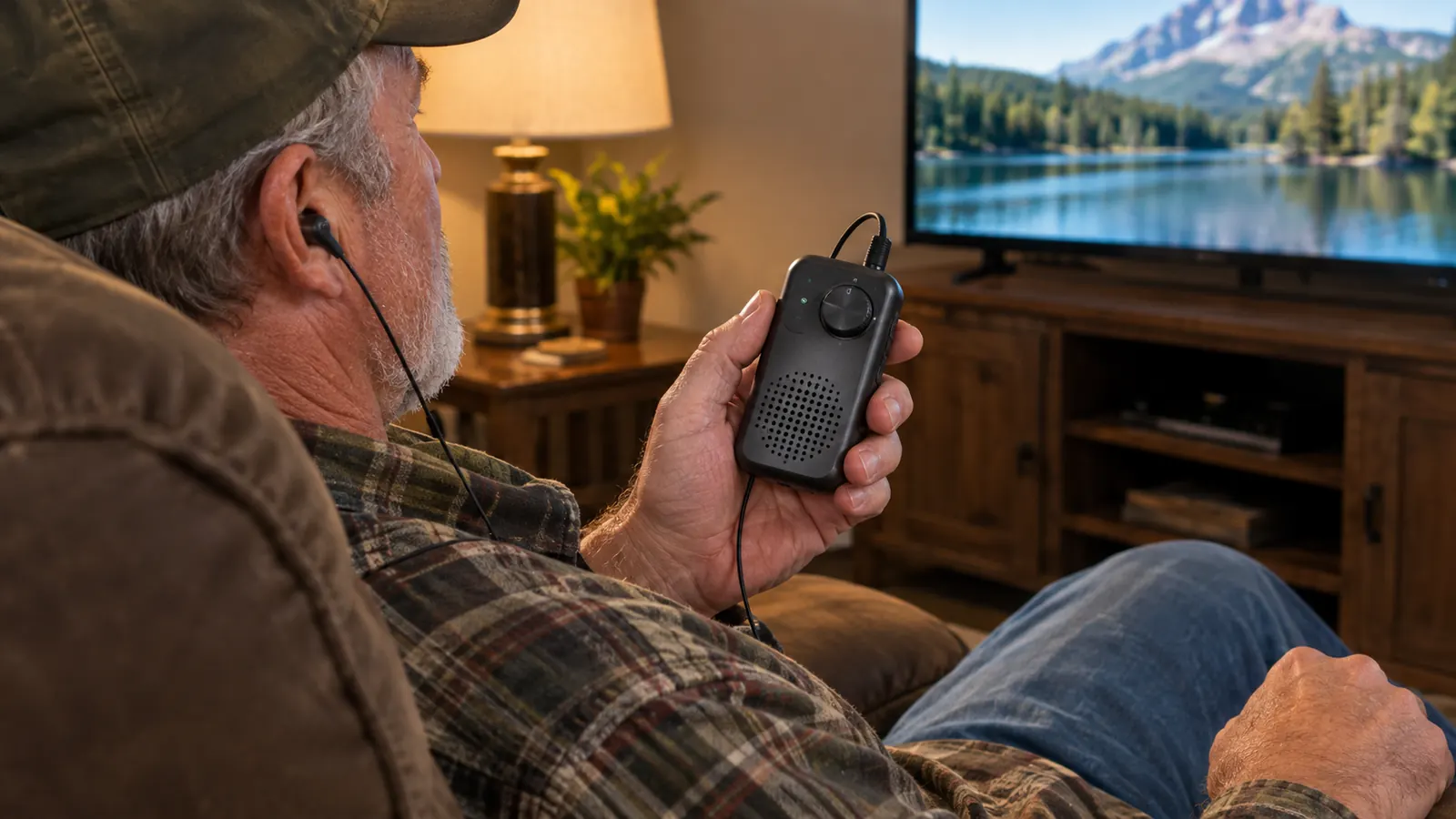
The Pocketalker Ultra is a small box with a microphone, a volume wheel, and a cord to a set of earbuds. You point the microphone at the person or the TV, and it turns up what is in front of you. It runs on one battery, and the box includes a year supply of them. That matters more than you would think for a gadget aimed at older hands that do not want to remember to charge another thing.
I have used it three ways: evening news and baseball from the recliner, one-on-one talk with Joanne at the kitchen table, and the occasional conversation with a neighbor who talks soft and fast. All three worked. None of them worked perfectly, and I will get to that. I have also been keeping notes as the weeks go by, and if you want the longer view, the long-term review of the Pocketalker Ultra covers how it holds up over months of daily use.
What Nobody Tells You About How It Sounds
Here is the first thing the reviews do not tell you: it amplifies everything, not just the voice you want. The microphone is directional, which helps, but it still picks up the crinkle of a snack bag, the hum of the refrigerator, and the click of a lamp switch. The first week, I heard Joanne's wristwatch tick. You trade one problem for a different, quieter set of problems.
The second thing is that your own voice sounds strange through it. When you speak while wearing the earbuds, your voice comes back at you with a hollow, canned quality. It took me about three days to get used to it, and Joanne laughed at me the first time I tried to hold a conversation while wearing them. The fix is simple: you do not need to wear both earbuds, and you do not need to talk much when the other person is the one you are trying to hear.
The third thing is direction. The microphone has to point at what you want to hear. If I turned my head to look at Joanne while the mic stayed pointed at the TV, I heard the TV. That sounds obvious, but it is the difference between this working and not working. My advice is to set the unit down on the table or the arm of the chair, pointed at the speaker, instead of wearing it around your neck like a medal.
One more honest note about batteries. A year supply sounds generous, and it is, but the unit goes through them faster than you expect if you leave it on. I have learned to switch it off when I take the earbuds out. The switch is small and easy to miss, so I put a piece of tape on the case to remind me. That is the kind of detail you only learn by living with the thing.
The Earbuds, the Battery Door, and the Volume Wheel
The included earbuds are fine. That is the honest word for them. They are lightweight, they fit well enough, and the sound is clear. They are not audiophile headphones, and the box does not claim they are. For a man who just wants to hear the weather report, they do the job. If you already own a comfortable pair of wired earbuds or headphones, you can use those instead, because the amplifier has a standard headphone jack.
The battery door is the part that will frustrate you. It is small, the hinge is stiff, and if your fingers are not as nimble as they were at forty, you will wrestle with it. Joanne has better hands than I do and she still grumbled the first time. The included year supply of batteries is a real kindness, but I wish the door were bigger and easier to open.
The volume wheel sits on the side of the unit, which means it gets bumped. Twice I sat down, turned it on, and heard nothing, because the wheel had been nudged to zero in my pocket. It is a five-second fix, but it is the kind of small annoyance that makes a gadget feel fussy. Learn where the wheel is and check it before you sit down, and you will be fine.
Where It Shines, and Where It Does Not
The Pocketalker Ultra shines at exactly two jobs. The first is TV at close range. From twelve feet, it turned the evening news from a mumble into actual words, and I could run the TV at a volume Joanne could live with. The second is one-on-one conversation in a quiet room. At the kitchen table, with the mic pointed at Joanne, I heard her better than I have in years. That alone made it worth the money.
The honest weak spot is noise. In a restaurant, or anywhere with background chatter and clattering plates, the amplifier turns everything up, and the result is a wall of sound. It does not sort out the voice you want from the noise you do not. I have read reviews from people who expected it to work in a crowded room, and I understand why they were disappointed. That is not what this box is for.
I have also learned that it is a tool I reach for, not something I wear all day. I put it on for the news, for a phone call, for a conversation with a soft talker. On Sunday mornings I call a buddy from the power company, and he talks soft and fast; with the mic pointed at the phone, I heard him the way I used to hear people. Then the unit goes back in the drawer. The people who get the most out of this device treat it like a pair of reading glasses: on when you need it, off when you do not.
The first night told me most of what I needed to know. I sat in the recliner, put in the right earbud, and set the unit on the arm of the chair with the mic pointed at the TV. The news came through clear enough that I heard the weather without asking Joanne to repeat it, and she did not have to leave the room the way she used to. It was not perfect: the crowd noise at the ballgame came through like a rumble, the earbud cord kept catching on the arm of the chair, and the microphone does not like being pointed at a window, because rain on the glass comes through louder than the TV. Small things. You learn them in the first week.
For the first time in three years, I watched a full baseball game without asking Joanne what the announcer said.

The Alternatives I Considered
Before I bought the Pocketalker Ultra, I tried the obvious things. Turning the TV up louder worked for me and drove Joanne out of the room, which is not a solution when you share a living room. A soundbar made the TV sound better but did not make the dialogue clearer for my ears. I also looked at hearing aids, and I will say more about those in a minute. Each of those options has a place. None of them solved the specific problem of hearing one voice in a quiet room.
I also looked at other personal sound amplifiers. The SuperEar SE5000 is the one people mention most often, and there is a side-by-side comparison of the Pocketalker Ultra and the SuperEar SE5000 if you are weighing two options. What sold me on the Williams Sound unit was the year supply of batteries and the simple controls. No app, no pairing, no charging dock. Just a wheel, a switch, and earbuds.
It Is Not a Hearing Aid, and You Should Know That
I need to say this plainly, because the marketing does not always say it: the Pocketalker Ultra is not a hearing aid. It is an assistive listening device. It makes sound louder, but it does not correct hearing loss, and it will not help you understand speech in a noisy room the way a properly fitted hearing aid can. I am a user, not an audiologist. If you have not had your hearing checked in a while, I would start there, not here.
That said, there is a real place for this kind of device. Hearing aids are expensive, and for mild to moderate loss, a personal sound amplifier can be a reasonable first step or a useful backup. It is also handy for the TV, because it puts the sound right at your ear instead of making the whole room listen to it. Just go into it with your eyes open about what it is and what it is not.
I went to a hearing clinic last spring, before I bought any of this. The test showed what I already suspected: high-frequency loss in both ears, worse on the left. The audiologist was honest with me, which I appreciated. She said a personal sound amplifier can help in quiet situations, and that is exactly the situation I bought it for. If you have not had that test done, that is where I would start.
What I Liked
- Makes TV dialogue and one-on-one conversation clearly louder
- Year supply of batteries included, nothing to charge
- Simple controls: a volume wheel and a switch
- Standard headphone jack, so you can use your own earbuds
- Small enough to carry in a shirt pocket
Where It Falls Short
- Amplifies background noise along with the voice you want
- Battery door is small and stiff for older fingers
- Volume wheel gets bumped and can end up at zero
- Your own voice sounds hollow through the earbuds
- Not a hearing aid and not a fix for noisy rooms
Who This Is For
Buy this if you have mild to moderate high-frequency loss, you lose dialogue on the TV, and you are tired of the volume wars with the person who shares your living room. Buy it if you want to hear one person clearly at the kitchen table. Buy it if you want an inexpensive, no-app, no-pairing tool that works the day it arrives. It is for people who want the TV loud for themselves without making everyone else listen to it.
It is also for people who are not ready for hearing aids, or who want a backup for the days when the good ear is tired. There is also a list of ten reasons a personal sound amplifier helps with everyday conversations, and most of those reasons have shown up in my own living room. If this sounds like you, the Pocketalker Ultra from Williams Sound is worth a try. I have no stake in whether you buy it. I just know it has made my evenings better.
Who Should Skip It
Skip it if your hearing loss is more than mild to moderate, or if your trouble is understanding speech in noisy places. Skip it if you are looking for something to wear all day, because this is a point-and-listen tool, not a replacement for your ears. And skip it if you have not seen a professional about your hearing recently. A personal sound amplifier should not be the first stop on that road.
I would also tell you to skip it if you expect perfection. The battery door is fiddly, the wheel gets bumped, and the sound is not natural. None of that has made me regret the purchase, because I knew what I was buying. The people who hate this device are usually the people who thought they were buying a hearing aid. Now you know better.
One more thing about skipping: do not buy this as a surprise gift for someone who has not asked for help with their hearing. I have seen that go badly. Hearing is personal, and a lot of people are not ready to admit they struggle. The ones who do well with this device are the ones who chose it for themselves, or who sat down and talked it through with their spouse first.
The honest bottom line: it works for what it is.
If you lose dialogue in a quiet room and want a simple, battery-powered fix, the Williams Sound Pocketalker Ultra has earned its place on my recliner. Check the current price on Amazon and decide for yourself.
Amazon Check Today's Price on Amazon →