
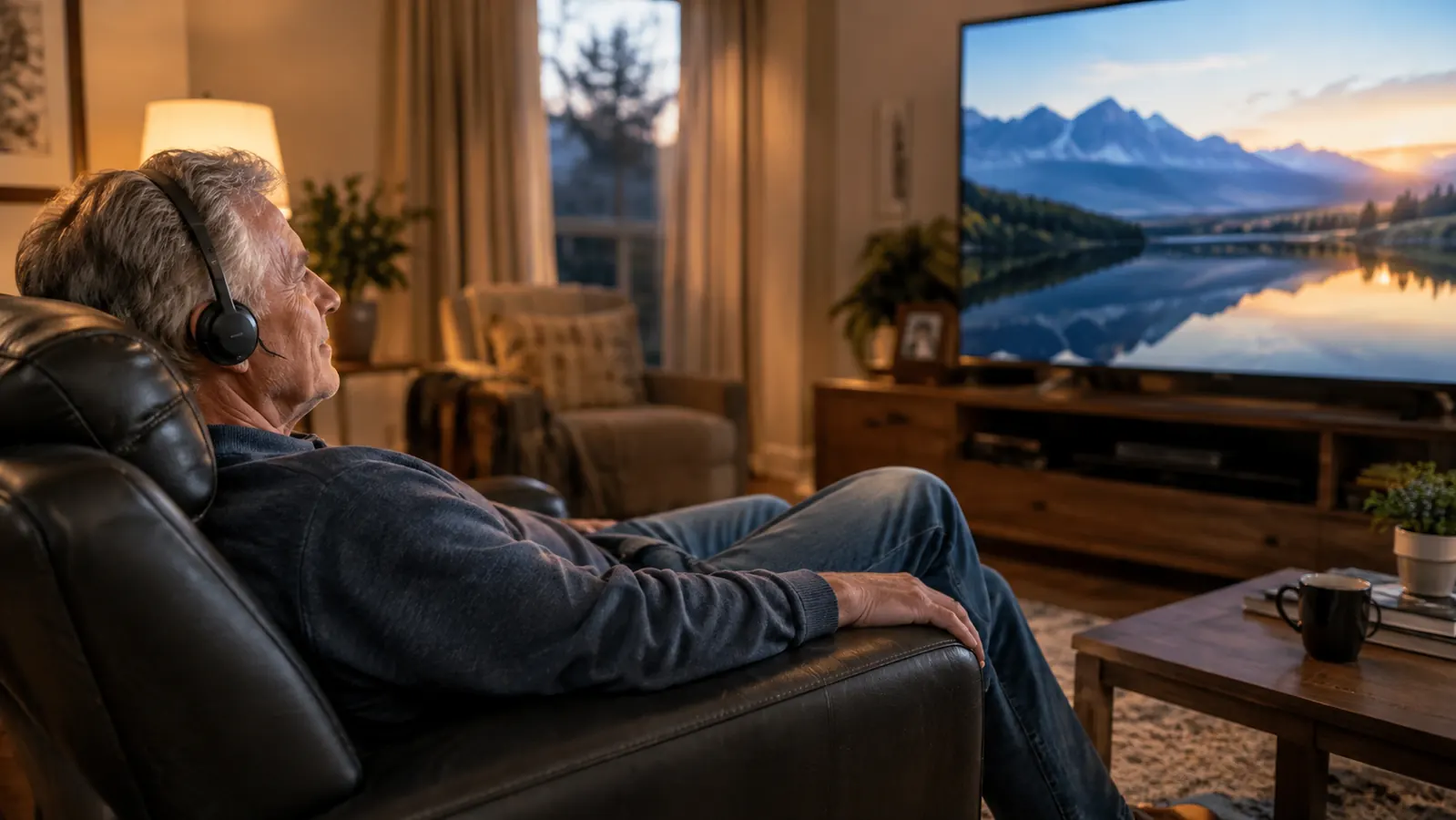
I am going to tell you things about the TV Ears 11741 that the product page will not. I am Walt, 69, retired electrical lineman, and I have worn hearing aids for the high-frequency loss in both ears for about eight years. My wife Joanne has normal hearing. For the last six months, the TV Ears 11741 has been the thing that lets us watch the same show in the same room without me turning the volume into a neighborhood announcement. It has also been, at times, a small exercise in patience. Here is the honest version.
Before I go further, the usual disclaimer: I am a user, not an audiologist. If you are struggling to hear conversation, not just the TV, please get a hearing test with a professional. This review assumes you have already done that or plan to. A headset will not fix hearing loss. It just makes the TV louder in your ears and nowhere else.
The Quick Verdict
A solid, comfortable wireless TV headset that solves the spouse-vs-volume war for good, as long as you accept its age, its charging quirks, and the fact that it is not a hearing aid.
Amazon Check Today's Price →Tired of the volume argument before 8 pm?
The TV Ears 11741 puts the dialogue where you need it, in your ears, and leaves the room at a level your spouse can live with. Check today's price on Amazon and read the recent buyer notes before you decide.
Amazon Check Today's Price on Amazon →How I've Used It
Our setup is simple: one living room, one 55-inch TV, my recliner about 12 feet from the screen, and Joanne on the couch. I used the TV Ears 11741 every evening for six months, which means a lot of westerns, a lot of baseball, and the news. I wore it for anything from 20 minutes to three hours at a stretch. The base unit plugs into the TV's audio output and broadcasts to the headset. You put the headset on, turn it on, and the TV sound comes to you at whatever volume you set, independently of the TV volume. Joanne can watch at her level, I can watch at mine, and neither of us has to apologize. That part works exactly as advertised, and it is worth a lot.
The first night, I had the base hooked up in about ten minutes. The instruction book is thin, but the setup is straightforward: one cable from the TV's audio output into the base, plug it in, set the headset on the base to charge, and you are done. I remember that first evening clearly because Joanne was skeptical. She watched me put the headset on and said, 'Let me see if I can still hear the TV.' She could, at her normal volume, and that was the moment she got on board. We watched a full hour of the evening news that night, which had not happened in years.
I charge the headset on the base every night out of habit, the way I used to hang up my work boots. That habit matters, because the battery is the part of this system that will test your patience. More on that in a moment. I tested the range one evening in April, out of curiosity, while Joanne was watching a show I did not care about. I walked to the kitchen at the back of the house, about 35 feet from the TV, through a doorway and around a corner, and the sound never stuttered. That surprised me. The first headset I tried would have cut out if I leaned forward. The range on this system is a real advantage, and it is the kind of thing you cannot tell from the product page.
What Nobody Tells You Before You Buy
First, the headset is not a hearing aid. It does not make speech clearer or separate voices from background noise. It makes everything louder, the way turning up the TV does, except only you hear it. For my kind of loss, where dialogue and soft voices go first, that is genuinely helpful. But if you are hoping it will fix the muddle of voices in a crowded room, it will not.
Second, the sound quality is fine, not impressive. It is a TV headset, not a pair of audiophile headphones. Voices are clear, which is the whole job, but music and action scenes sound a little thin. My brother-in-law tried them once and called them 'functional.' I would say the same thing, and I mean it as a compliment.
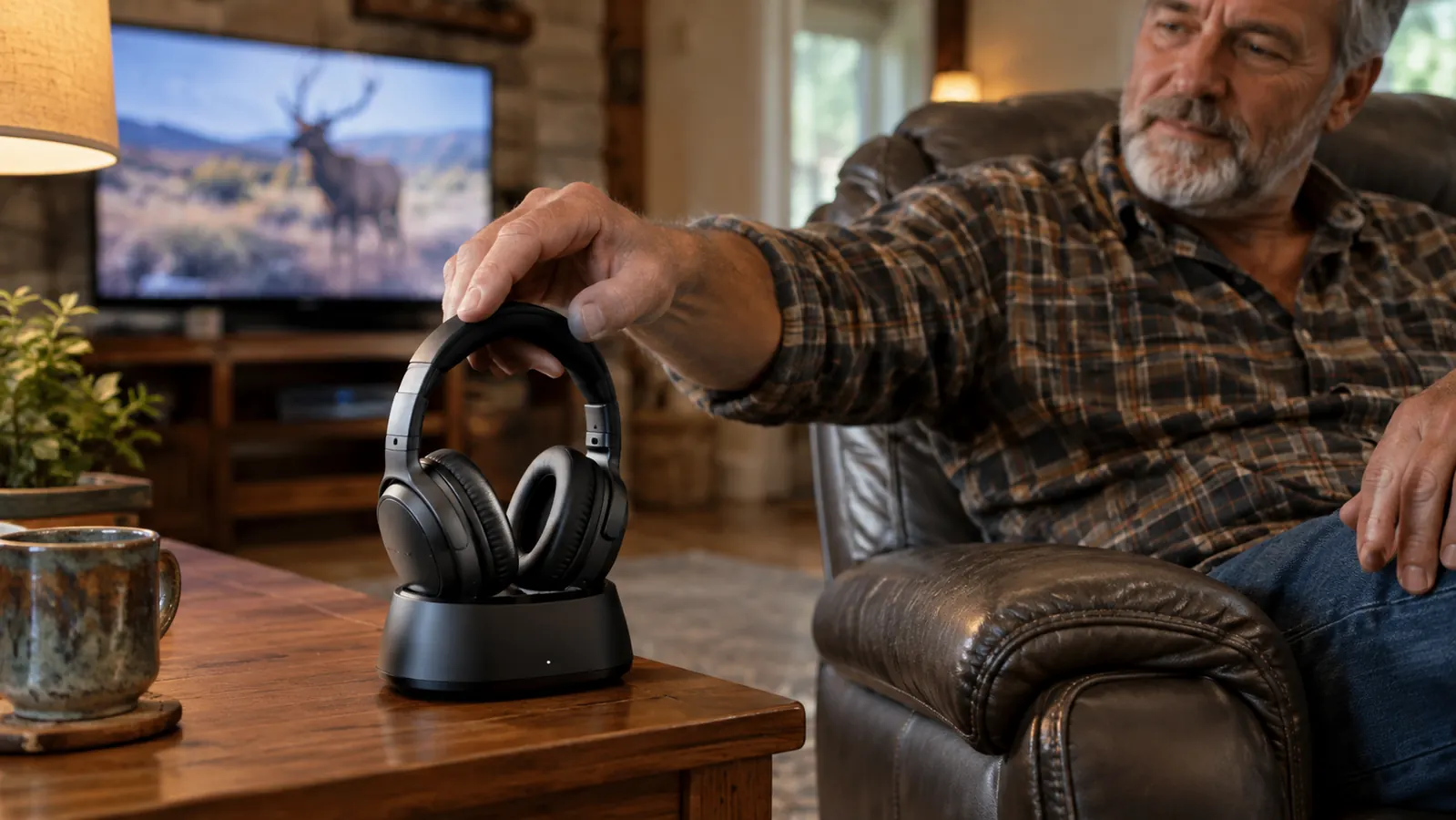
Third, the TV Ears 11741 is an older design, and it shows. The charging base is fussy. The headset has to sit on it just right, or it does not charge, and you find out the next evening when the battery dies 20 minutes into the news. I learned to run my hand across the base after setting it down to make sure it clicked into place.
The headset also has a volume wheel on the right earpiece, and it takes a few evenings to find your setting. I keep mine about two-thirds up. Joanne tried the headset out of curiosity one Sunday afternoon, and she said it was loud at half. That tells you something about how differently we hear, and it is exactly why this product works: my setting does not touch hers. And one more thing the box does not tell you: the headset pauses nothing. If I get up to answer the door, the TV keeps playing for Joanne, which is the point, but I will miss whatever happened while I was gone. I learned to hit pause on the remote before I get up, and that has become a habit.
What I Liked
- Ends the nightly volume argument completely; Joanne watches at her level while I watch at mine
- Range is genuinely good; no dropouts in six months, even from the kitchen 35 feet away
- Lightweight and comfortable for three-hour stretches; clears my glasses without pressing
- Simple setup, one cable from the TV, no app, no remote to learn
- Independent volume means I catch dialogue and soft voices I used to miss
Where It Falls Short
- Battery life is only okay, and the charging base is fussy about alignment
- No warning when the battery is about to die; the sound just stops
- Sound is fine for voices but thin for music and action scenes
- One-listener system; two people with hearing loss need a different product
- Not a hearing aid; it makes things louder but does not clarify speech
The battery is the part of this system that will test your patience, and the fix is a two-second habit: make sure the headset clicked onto the base before you walk away.
The Volume Test That Mattered Most
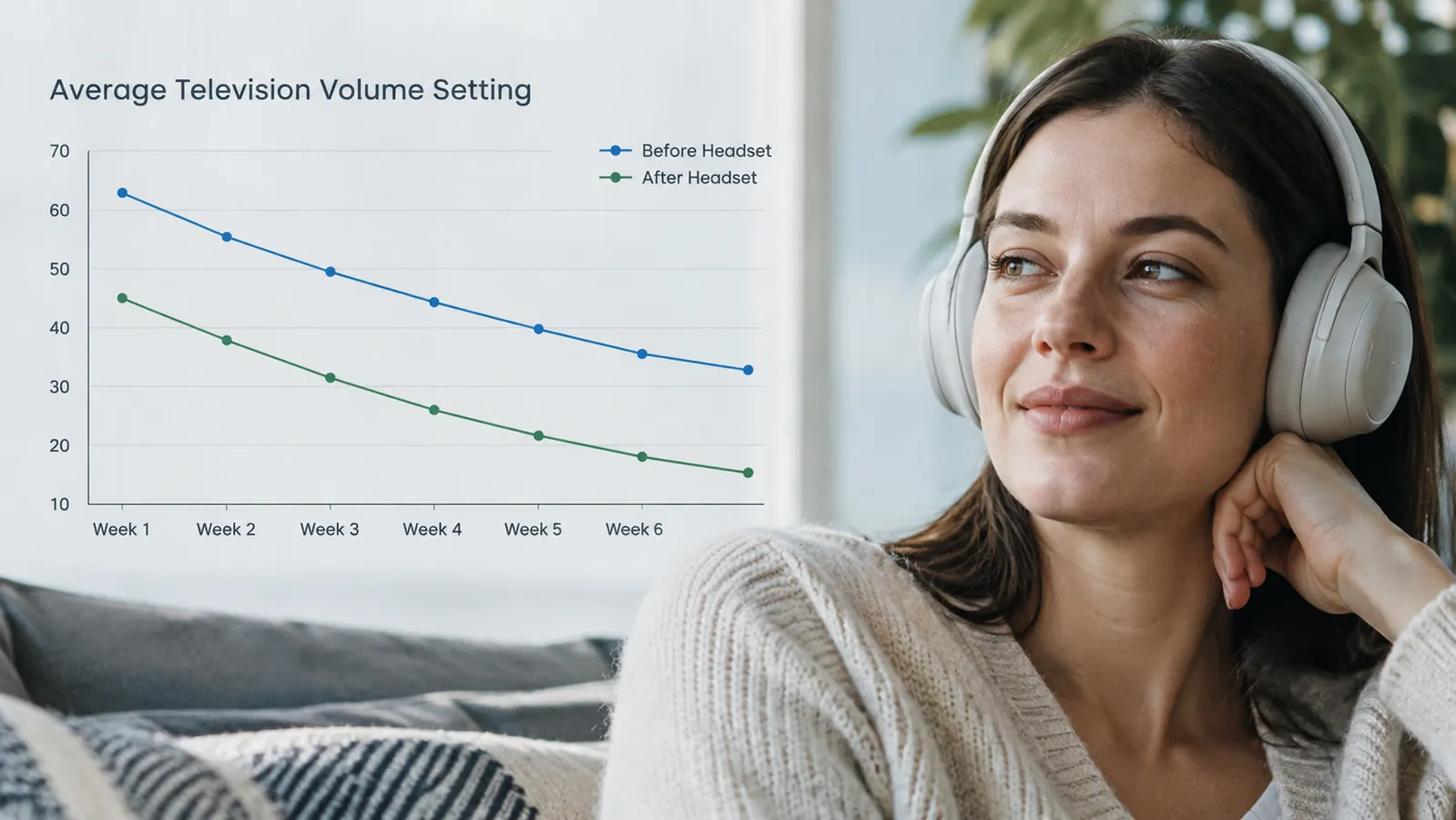
Before the TV Ears, Joanne and I had the same conversation every single night. She would say the TV was too loud. I would say I could not hear it. She would turn it down, I would turn it up, and by 9 pm we were both annoyed. That is the real problem this product solves, and it solves it completely.
After the first week, I stopped touching the TV volume. The TV sits at a level Joanne calls comfortable, and I adjust my headset instead. We have not had the volume conversation in months. If your household has that same nightly argument, that alone may be worth it.
The headset also helped in a way I did not expect: I stopped asking Joanne what the newscaster just said. With the volume in my ears, I catch the names, the places, the score. She has told me more than once that she forgot I was wearing it, which is the highest compliment a spouse can give a TV headset.
One Tuesday in March, an old western came on, and I realized halfway through that I was following the dialogue without trying. That had not been true for years. I used to miss the setup lines and piece the story together from the action. With the headset, I heard the quiet scenes, the soft-spoken parts, the lines the actors deliver under their breath. Joanne noticed too. She said, 'You laughed at that joke,' and she was right, and I had, because I had actually heard it.
The Charging Quirks and the Battery Life
Here is the honest part. The battery life is okay, not great. A full charge got me through two or three evenings of normal viewing. If I forgot to put the headset on the base properly, I found out the next night. The base has a light, and the instruction book says it tells you the charging status, but I could never trust it. The click of the headset seating into the base was my real indicator.
I also learned not to wear the headset while it is on the base. It charges through contacts on the band, and the headset is not comfortable to wear while it is sitting there. That sounds obvious, but I mention it because the base is shaped like a small stand, and more than one reviewer has tried to use it that way.
The headset itself is lightweight, and the padding over the ears is soft. I wear glasses, and the band cleared the arms without pressing them into my head. After three hours of baseball, my ears were warm but not sore. That is better than I can say for the first wireless headset I tried, which pinched within 40 minutes.
One night in July, with two outs left in a ballgame, the headset went silent. Not a fade, just dead. I had set it on the base the night before, but I had been in a hurry and it had not clicked into place. The light on the base was on, which is what fooled me, but the contacts were not touching. That was the night I learned to run my hand across the band and feel the little snap before I walk away. It has not happened since, and I will be honest: that one was on me, not the product. I should also say how I know the battery is done: there is no warning tone. The sound just stops. The first time it happened, I thought the TV had gone quiet, but Joanne was still watching fine. Now the silence tells me the headset is out of charge, and I check the base before I blame the TV.
Who This Is For
The TV Ears 11741 is for the person with mild to moderate hearing loss who wants to watch TV with their spouse again. It is for the household where the volume is a nightly argument. It is for the person who does not want to wear hearing aids around the house just to watch the evening news, and who wants something simpler than a full surround-sound system with a remote control they will never learn.
It is also for the spouse with normal hearing. Joanne is the one who originally asked me to turn the TV down, and she is the one who benefits most on paper. A headset that only the person with hearing loss wears is a much smaller change to the room than a soundbar, a hearing loop, or a second TV.
One more thing: this is not a product you need to learn. There is no app, no pairing, no software to update. My brother-in-law, who is not handy with electronics, put the headset on and had it working in under a minute. That matters more than you might think when the product is meant for people in their sixties and seventies.
Who Should Skip It
Skip the TV Ears 11741 if you have severe hearing loss and need the TV very loud. The headset gets loud, but it is not a hearing aid, and it does not clarify speech the way a professionally fitted hearing aid can. If you are already wearing hearing aids and just want the TV to feed into them, look for a TV streamer made by your hearing aid brand instead.
Skip it if you want to watch TV with another person who also has hearing loss. This system is one headset, one listener. Two headsets for one TV is a different product, and I would not try to rig this one. Skip it if you are not willing to build the charging habit, because the battery will let you down eventually, and it will do it at the worst moment.
And be honest with yourself about the sound. If you are the kind of person who notices subtle differences in audio quality, the TV Ears 11741 will not impress you. It is built for clear voices at a comfortable volume, not for audio fidelity. That is the trade you are making.
One more situation worth naming: if you mostly watch TV alone, at your own volume, and nobody is complaining, you may not need this at all. The TV Ears 11741 shines in a shared room. By yourself, a decent pair of headphones plugged into the TV would do the same job with fewer parts and no charging base to fuss with. Buy it for the peace it brings to the room, not for the sound alone.
Alternatives I Considered
Before the infrared headset, I tried the simplest thing first: closed captions. That worked for me, but Joanne found the captions distracting, and she was the one who had to watch them too. Then I tried earbuds plugged into the TV remote, which meant a cord across the living room and a remote I had to carry everywhere. The TV Ears 11741 was the third thing I tried, and it was the first one that did not ask Joanne to change anything about how she watches TV.
I tried a cheaper infrared headset next. It worked only when I sat in a direct line with the TV, and the sound cut out every time I leaned forward to pick up my coffee. The TV Ears uses a different transmission, and I have not had a dropout in six months, even when I walked into the kitchen at the back of the house with the headset still on. That range is a real advantage.
I also considered a soundbar with a dialogue-enhancement mode, and I still think that is a good option for someone who lives alone and wants the whole room to sound better. But Joanne does not need the TV louder, and a soundbar makes it louder for both of us. The headset is the only option that fixes the problem for one person without changing anything for the other.
I also looked at a pair of wireless headphones made for music, the kind with noise canceling. They would have sounded better, but they do not come with a base that plugs into the TV, so I would have needed a Bluetooth transmitter: another box, another power cord, another set of instructions. I am 69 years old, and I have learned that every extra box is a box that will eventually need troubleshooting at 9 pm. The TV Ears system is one box, and it has needed no troubleshooting since I learned the charging habit.
Still deciding whether the TV Ears 11741 fits your living room?
It fixed the nightly volume argument in our house, and the range surprised me. If that is the problem you are trying to solve, check today's price on Amazon and read the recent reviews from buyers in your situation.
Amazon Check Today's Price on Amazon →