
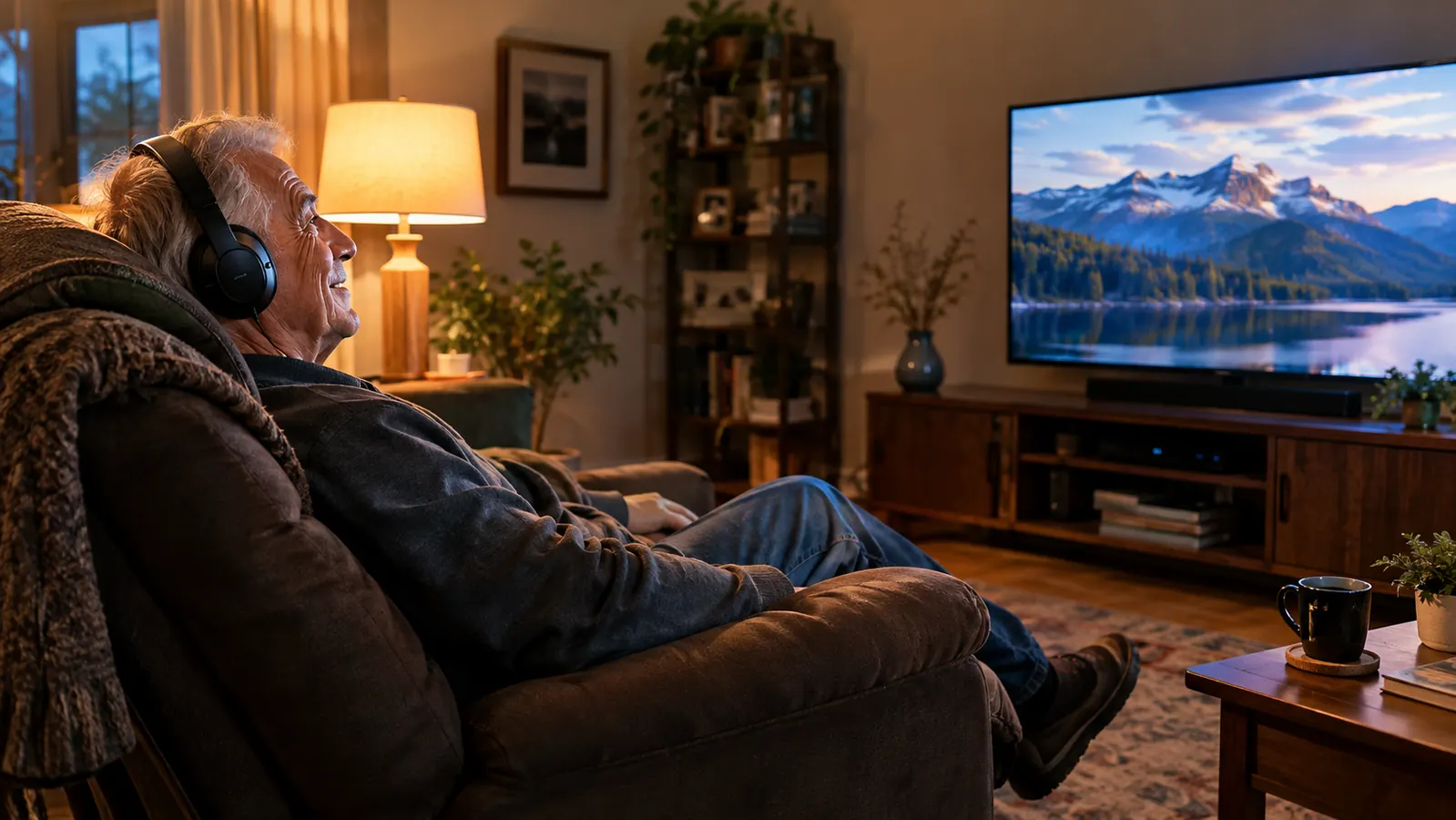
If you cannot hear the TV well and your spouse can hear it fine, you already know the argument. You turn it up, she turns it down, and everybody goes to bed a little irritated. I have been on both sides of that argument for years. My name is Walt Kesler, I am 69, and I spent 34 years as a lineman with the power company. The ringing and the high-frequency loss came with the job. My left ear is worse than my right, and dialogue is the first thing I lose. Before I bought either of these systems, I tried the cheap fixes. I turned the TV up until Joanne left the room. I bought a soundbar, and it made explosions louder without making the news anchor any clearer. I tried a pair of earbuds on a long cord, and I got tangled up every time I reached for my coffee. None of it worked, because the problem was not volume. The problem is that my ears do not separate voices from background noise the way they used to. The TV Ears system and the Avantree Ensemble are two of the most common fixes people try, and they solve the problem in completely different ways. I tested both in my living room, on my own TV, with my own ears, and this is the honest difference.
The short answer: TV Ears is the system I recommend for most couples in my situation. It is simpler, it is built specifically for clear speech, and my wife Joanne stopped asking me to turn the TV down within a week. The Avantree Ensemble is a fine product with a wider range and a lower price, but it asks more of you at setup and it does not do the one job I needed most, which is making dialogue sound clean at low volume. I ran both systems side by side for about six weeks, switching back and forth on different nights so I could compare them on the same shows. That is the only fair way I know to test this kind of thing. Here is the full picture.
| TV Ears 11741 | Avantree Ensemble | |
|---|---|---|
| What it is | A headset and base station made for TV listening, with an optional second headset | A transmitter that sends TV audio to a pair of wireless headphones |
| Best for | One or two people who want clear dialogue without turning up the room volume | A person who wants to move around the house while listening |
| TV compatibility | Works with nearly any TV with audio out, including older models | Works with nearly any TV with audio out, including older models |
| Wireless range | About 30 feet, plenty for one living room | Up to 300 feet, so you can keep listening in the kitchen or garage |
| Ease of setup | Plug in the base, connect one cable, put the headset on the base to charge | More cables and a pairing step; the manual is longer than it needs to be |
| Dialogue clarity | Tuned for speech, with volume controls on the headset | Good sound, but less focused on voice than on full-range audio |
| Battery and charging | Headset charges in the base, so it is almost always ready | Rechargeable batteries, but you have to remember to charge them |
| Who wears it | One person, with an optional second headset | One or two people with two headphones |
| Volume and balance | Volume and balance controls on the headset, so you adjust without the TV remote | Volume on the headphones, but no balance control |
| Price | Usually costs more, but the headset charges itself in the base | Usually costs less and includes two headphones |
| What's in the box | Base station, one headset, cables | Transmitter, two headphones, cables |
| Setup time | About five minutes, one cable | About 20 minutes with the manual open for pairing |
| Sound profile | Focused on voices and dialogue | Full-range sound, good for music and movies |
Where TV Ears Wins
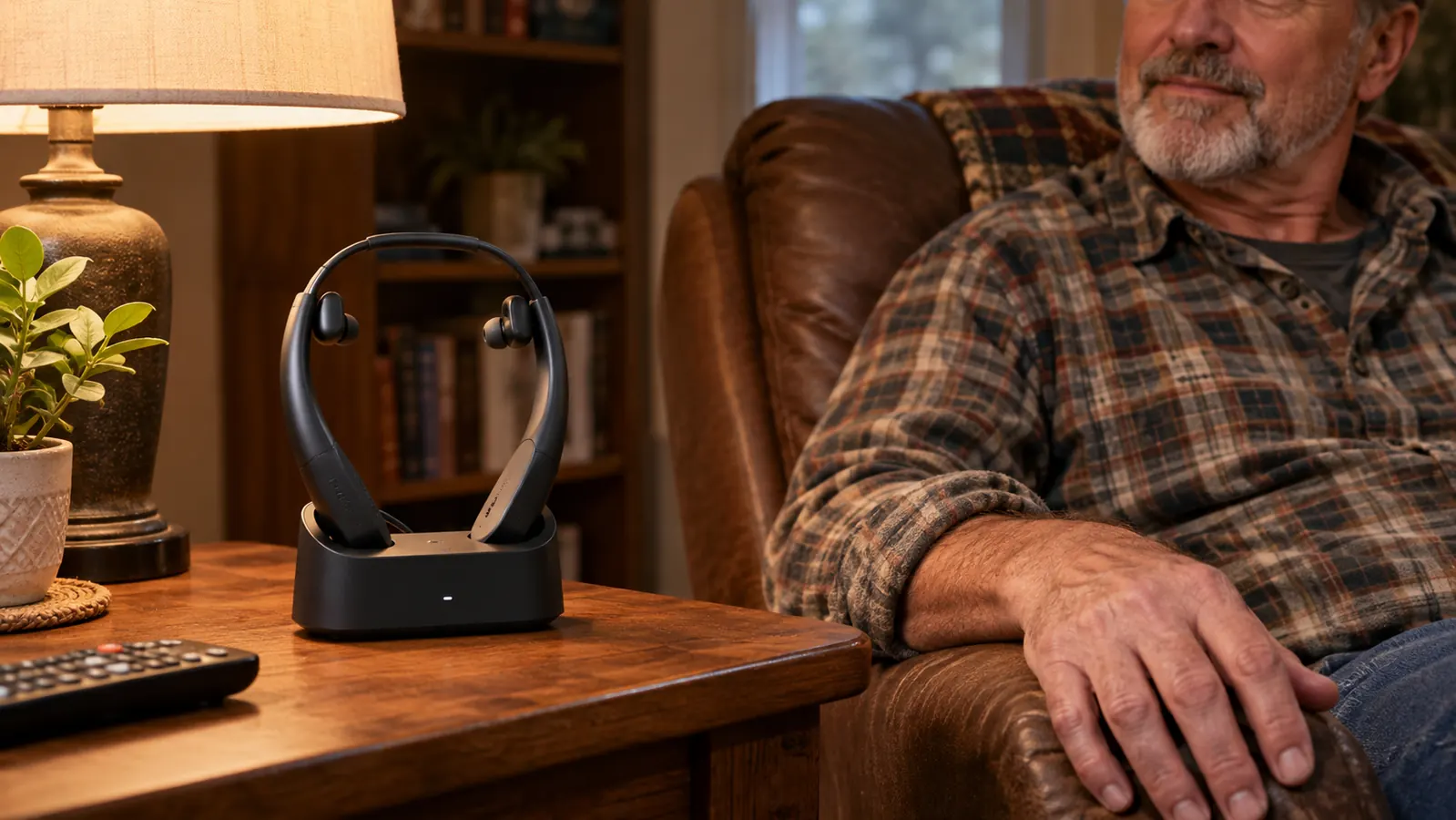
TV Ears wins on the two things that matter most in a shared living room: simplicity and speech. The base station sits on the end table beside my recliner, about 12 feet from the TV. One cable runs from the base to the audio out on the TV, and that was the whole installation. No pairing, no app, no menu digging. The headset lives on the base and charges whenever it is not on my head, so it is always ready when the news comes on. Joanne does not have to do anything. That was the point. I set mine up on a Tuesday night in March, after the mail came. It took longer to unpack the box than it did to connect the cable. The base has a little light that comes on when the headset is seated and charging, and that light is the only thing I have ever had to look at since. The headset itself is light enough that I forget I am wearing it, which is the highest compliment I can give any piece of gear.
The sound is what sold me. TV Ears is not trying to be a music headphone. It is trying to make voices clear, and it does. On the evening news, on a western, even on a baseball broadcast, the announcer's voice comes through clean while the room stays at a normal volume. The volume control on the headset let me find my level without touching the TV remote. My left ear is worse than my right, and the balance control helped there too. That is the feature I did not know I needed until I used it. The first night, I put the headset on during the 6:30 news and forgot I was wearing it until the sports came on. Joanne was reading in her chair across the room, and she did not say a word about the volume. That had not happened in years. The balance control is a small wheel on the headset, and it let me give my left ear a little more gain without making the right ear uncomfortable. No other TV headset I have tried has that. It matters more than you would think when one ear is worse than the other.
There is also a second headset you can add to the TV Ears system if Joanne ever wants to listen with me. I have not needed it because her hearing is fine, but it is nice to know the option is there. The system is built for one living room, and that is exactly what I have. It does not try to broadcast to the whole house, and I do not need it to. The tradeoff is real: if you want to wander into the kitchen and keep listening, TV Ears will not follow you. For me, that is a tradeoff I am happy to make.
Where the Avantree Ensemble Wins
I will give the Avantree Ensemble its due. It has two real advantages, and for some people those advantages will decide the sale. First, the range. The Ensemble transmits up to 300 feet, which means you can leave the living room and keep listening. Joanne tested it while she was in the kitchen making supper and the audio never dropped. If you are the person who likes to move around the house, or if you watch TV in a room that is far from where the transmitter sits, the Ensemble is the better tool. That is just the truth. One Saturday afternoon I wore the Ensemble headphones out to the garage to work on a shop light while the ballgame was on. The broadcast stayed clear the whole time, through two interior walls and a closed door. The TV Ears headset drops out around the hallway, so that is a genuine difference, not a marketing number. For a person who spends their evening moving between the living room and the kitchen, that range is the whole ballgame.
Second, the price. The Ensemble usually costs less than the TV Ears system, and it comes with two headphones in the box. For a couple who both want to listen, that is a real saving. The tradeoff is that you get more for less, but you also get more to manage. The setup took me about 20 minutes with the manual open, and the headphones need to be paired to the transmitter before they work. It is not hard, but it is more than the TV Ears base station asked of me. If you are comfortable with a little technology, the Ensemble is a solid value. The pairing step tripped me up at first because I did it in the wrong order. The manual says to plug the transmitter in, then put the headphones on charge, then hold the pairing button on both. I skipped the charging step and spent ten minutes wondering why the left headphone would not connect. Once I followed the order, it worked the first time. That is the whole story of the Ensemble: it rewards patience, and it punishes rushing. If you would rather not read a manual at all, factor that in.
The sound is different too, and not in a bad way. The Ensemble plays full-range audio, so music and movie soundtracks have more body to them than the TV Ears headset. When I watched a western with a lot of wind and horses, the Ensemble made it feel bigger. The tradeoff is that voices sit inside the mix instead of on top of it, so I found myself reaching for the volume control more often during dialogue-heavy shows. For the baseball games I watch, the crowd noise and the announcer both came through fine. It is a good headphone. It is just aimed at a different job.
Hear the dialogue without turning up the TV
The TV Ears 11741 is the system I keep in my living room. It charges itself, connects in a few minutes, and makes voices clear while the room stays quiet. Check today's price on Amazon to see if it fits your setup.
Amazon Check Today's Price on Amazon →
Who Should Buy Which
Buy the TV Ears system if you want the fix that disappears into your routine. It is for the person who does not want to read a manual, who wants the headset ready every evening, and who mainly watches TV in one room. It is for the spouse who is tired of the volume argument and wants it gone without a project. It is the system I use every night, and it is the one I recommend to my friends who ask. My neighbor Bill asked me about it after he and his wife had the same argument at a Super Bowl party. I told him the same thing I will tell you: if you watch in one room and you mainly care about hearing the dialogue, this is the one. He bought it, and the last time we talked he said the only problem is that his wife keeps borrowing the headset. That is the kind of problem you want to have.
Buy the TV Ears system if one ear is worse than the other. The balance control alone is worth the difference for me. I set mine once, and I have not touched it since. I also like that the headset charges itself, because I am the kind of person who will forget to plug anything in. The base makes the decision for me. I have gone through more rechargeable batteries than I care to count, and I have missed the first ten minutes of plenty of ballgames because the headphones were dead. With the TV Ears base, the headset is charging every minute it is not on my head, so dead is not a state the system has. That is the kind of small thing that determines whether a product actually gets used or ends up in a drawer.
Buy the Avantree Ensemble if you need range or a second pair of headphones. If you listen while you cook, if you have a big house, or if you and your spouse both want to watch with headsets on, the Ensemble is the practical choice. It is a good product. It just did not fit the way I live. Think about your own week before you decide. Do you actually sit in one chair for a whole show, or are you up and down getting water, checking on something, moving laundry? If you are the kind of person who watches with your hands busy, the range of the Ensemble is worth more than the simplicity of the TV Ears. Both of these products do what they claim. The question is which claim matches your house.
Here is my honest bottom line. I kept the TV Ears system in my living room because it solves the argument that was actually happening in my house. Joanne reads in her chair, I watch the news, and neither of us has to say a word about the volume. The Ensemble is back in its box in the closet, not because it is a bad product, but because my TV does not move and neither do I. If your situation is different, buy the one that matches it. That is the whole point of this comparison.
Still deciding? Start with the one that is always ready
The TV Ears 11741 charges itself, connects in minutes, and makes dialogue clear without turning up the room. That is why it is the system in my living room. See today's price on Amazon and decide for yourself.
Amazon Check Today's Price on Amazon →